
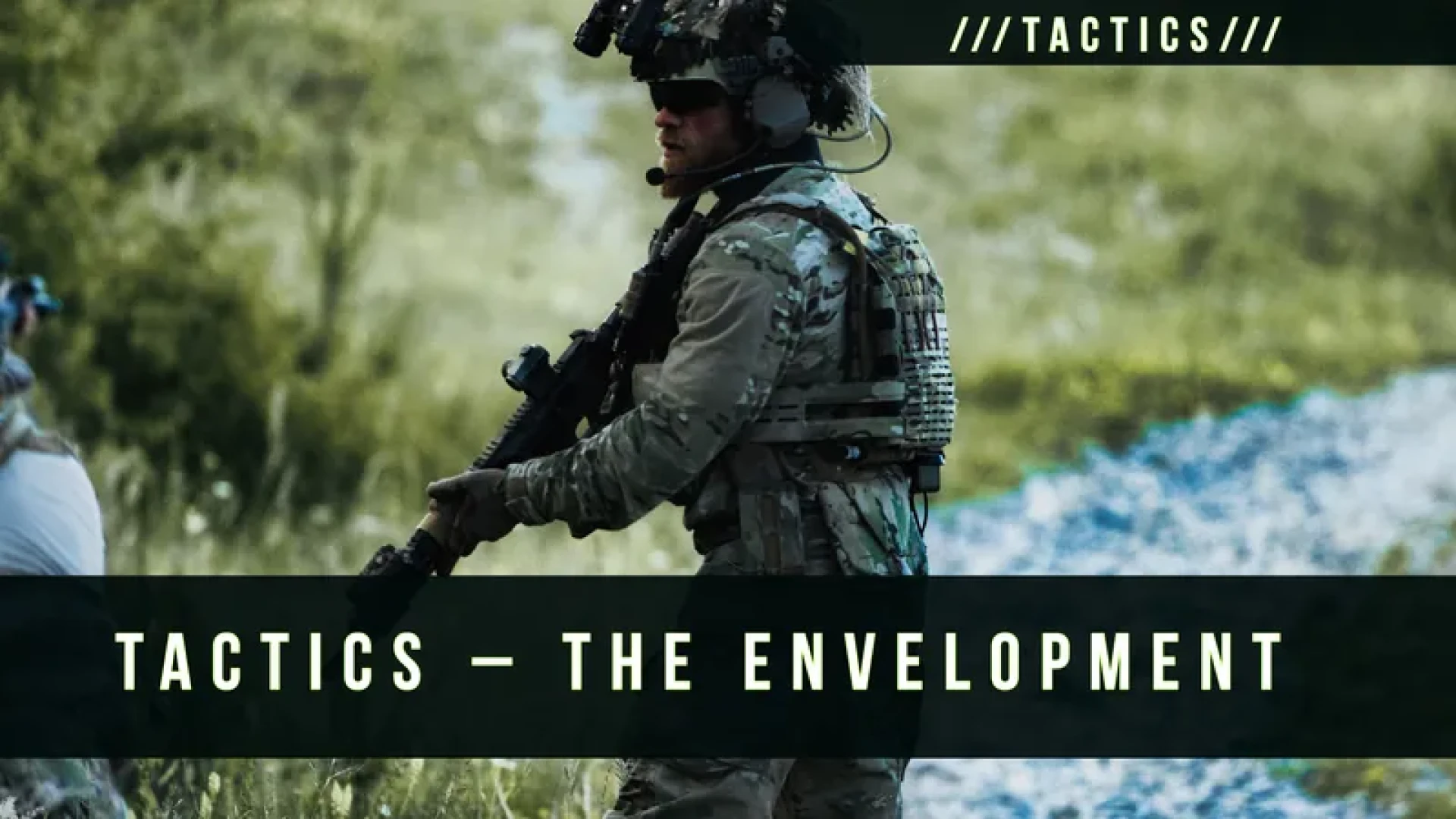
RedbeardTactical - Tactics - The Envelopment
infoAbout This Title
Before interrupting our series, it is time to cover one of the most well-known tactics: the envelopment. While the layman often perceives the feint as the ultimate display of tactical competence, the envelopment is what the maneuverist truly seeks.
Generally, the envelopment is a cornerstone of maneuver warfare. Enveloping the enemy stacks the odds and opens up new possibilities on the battlefield. A successful envelopment allows a commander to achieve one of two outcomes: A) Destroy the enveloped enemy force. B) Bypass the enveloped enemy force.
Option B is an absolute cornerstone of maneuver warfare. Enemy forces can be pinned with relatively little effort, allowing the main body of our forces to advance toward the enemy's center of gravity. (Note: A containment force is usually left behind to ensure the trapped enemy cannot break out and strike vulnerable logistics). Even if the enemy eventually breaks out of the envelopment, they will have lost valuable time and assets doing so.
Execution: The Single Envelopment
There is not just one way to conduct this maneuver, but the basic form of this tactic is the single envelopment. To execute it successfully, a commander must sequence the following steps:
Fix the Enemy (The Frontal Attack): Conduct a frontal attack utilizing a fixing force. This force keeps the enemy occupied and pinned in place so they cannot reposition.
Flank (The Main Effort): The main effort—the enveloping force—flanks the enemy, retaining contact while advancing to ensure the enemy cannot slip away.
Deploy to the Rear: The enveloping force deploys and makes contact at the enemy's rear, effectively trapping them against the fixing force.
Close the Trap: The enveloping force closes the envelopment, cutting off the enemy completely.
The End State: The enemy is isolated and forced to split their firepower in all directions, rendering them highly vulnerable to destruction or bypass.
The Double Envelopment
The double envelopment involves two enveloping forces advancing simultaneously on both the left and right flanks. While it sounds faster and more decisive on paper, it requires meticulous planning and highly skilled troops; otherwise, friendly fire incidents are almost certain.
Strict limits of advance and other Tactical Control Measures (TCMs) are of utter importance when conducting a double envelopment. Furthermore, the sheer volume of forces required is significantly higher than a simple flanking attack.
Historical Relevance and Airborne Operations
Contrary to the feint and the turning movement, which are rarer forms of maneuver today, military history is filled with envelopments. From the Battle of Cannae in antiquity to Stalingrad in WWII, the US envelopment of Kuwait during the Gulf War, and the Ukrainian counteroffensives of 2022, this tactic is ubiquitous.
Once an envelopment is complete, there is little the trapped force can do aside from launching desperate breakthrough efforts. It cannot move, it cannot sustain itself, and often, it cannot even communicate.
Vertical envelopments using air-mobile and airborne forces are highly effective here. Speed is essential—as soon as the enemy recognizes your intent, they will do everything to stop the maneuver. This also highlights how an envelopment can be used as a feint: a commander can hypothetically set up a credible enveloping force as a shaping effort, then bring the main effort to bear against the now-disrupted defender.
Drawbacks and Friction
Aside from the command and control friction already mentioned, the envelopment comes with several drawbacks:
Personnel Requirements: You need significant troop strength. Commanders must calculate if pulling off an envelopment is an efficient use of resources compared to simply flanking the enemy.
Terrain & Surfaces: Terrain, along with the enemy's "surfaces and gaps" (strengths and weaknesses), dictates feasibility.
Operational Friction: An enveloping force stretches its own logistics and communication lines, making it vulnerable to a "defeat in detail." It is not unheard of for an enveloping force to become enveloped itself.
Small Unit Tactics
The use of true envelopments in small unit tactics is rare, as the required personnel ratio is usually not worth it at the squad or platoon level. However, establishing the support and security perimeters during a raid can be perceived as a micro-envelopment.
Conversely, in urban combat, small-unit envelopments are common. Isolating enemy forces fortified inside specific buildings is often much more effective—and less costly—than mounting a direct assault on the structure.
Generally speaking, the envelopment is one of the most important forms of maneuver. While you may rarely conduct a true envelopment when commanding a squad or platoon, your unit will frequently be part of larger-scale envelopments. Therefore, mastering this tactic is critical for understanding the commander's intent.
Before interrupting our series, it is time to cover one of the most well-known tactics: the envelopment. While the layman often perceives the feint as the ultimate display of tactical competence, the envelopment is what the maneuverist truly seeks.
Generally, the envelopment is a cornerstone of maneuver warfare. Enveloping the enemy stacks the odds and opens up new possibilities on the battlefield. A successful envelopment allows a commander to achieve one of two outcomes: A) Destroy the enveloped enemy force. B) Bypass the enveloped enemy force.
Option B is an absolute cornerstone of maneuver warfare. Enemy forces can be pinned with relatively little effort, allowing the main body of our forces to advance toward the enemy's center of gravity. (Note: A containment force is usually left behind to ensure the trapped enemy cannot break out and strike vulnerable logistics). Even if the enemy eventually breaks out of the envelopment, they will have lost valuable time and assets doing so.
Execution: The Single Envelopment
There is not just one way to conduct this maneuver, but the basic form of this tactic is the single envelopment. To execute it successfully, a commander must sequence the following steps:
Fix the Enemy (The Frontal Attack): Conduct a frontal attack utilizing a fixing force. This force keeps the enemy occupied and pinned in place so they cannot reposition.
Flank (The Main Effort): The main effort—the enveloping force—flanks the enemy, retaining contact while advancing to ensure the enemy cannot slip away.
Deploy to the Rear: The enveloping force deploys and makes contact at the enemy's rear, effectively trapping them against the fixing force.
Close the Trap: The enveloping force closes the envelopment, cutting off the enemy completely.
The End State: The enemy is isolated and forced to split their firepower in all directions, rendering them highly vulnerable to destruction or bypass.
The Double Envelopment
The double envelopment involves two enveloping forces advancing simultaneously on both the left and right flanks. While it sounds faster and more decisive on paper, it requires meticulous planning and highly skilled troops; otherwise, friendly fire incidents are almost certain.
Strict limits of advance and other Tactical Control Measures (TCMs) are of utter importance when conducting a double envelopment. Furthermore, the sheer volume of forces required is significantly higher than a simple flanking attack.
Historical Relevance and Airborne Operations
Contrary to the feint and the turning movement, which are rarer forms of maneuver today, military history is filled with envelopments. From the Battle of Cannae in antiquity to Stalingrad in WWII, the US envelopment of Kuwait during the Gulf War, and the Ukrainian counteroffensives of 2022, this tactic is ubiquitous.
Once an envelopment is complete, there is little the trapped force can do aside from launching desperate breakthrough efforts. It cannot move, it cannot sustain itself, and often, it cannot even communicate.
Vertical envelopments using air-mobile and airborne forces are highly effective here. Speed is essential—as soon as the enemy recognizes your intent, they will do everything to stop the maneuver. This also highlights how an envelopment can be used as a feint: a commander can hypothetically set up a credible enveloping force as a shaping effort, then bring the main effort to bear against the now-disrupted defender.
Drawbacks and Friction
Aside from the command and control friction already mentioned, the envelopment comes with several drawbacks:
Personnel Requirements: You need significant troop strength. Commanders must calculate if pulling off an envelopment is an efficient use of resources compared to simply flanking the enemy.
Terrain & Surfaces: Terrain, along with the enemy's "surfaces and gaps" (strengths and weaknesses), dictates feasibility.
Operational Friction: An enveloping force stretches its own logistics and communication lines, making it vulnerable to a "defeat in detail." It is not unheard of for an enveloping force to become enveloped itself.
Small Unit Tactics
The use of true envelopments in small unit tactics is rare, as the required personnel ratio is usually not worth it at the squad or platoon level. However, establishing the support and security perimeters during a raid can be perceived as a micro-envelopment.
Conversely, in urban combat, small-unit envelopments are common. Isolating enemy forces fortified inside specific buildings is often much more effective—and less costly—than mounting a direct assault on the structure.
Generally speaking, the envelopment is one of the most important forms of maneuver. While you may rarely conduct a true envelopment when commanding a squad or platoon, your unit will frequently be part of larger-scale envelopments. Therefore, mastering this tactic is critical for understanding the commander's intent.
Comments (0)