
Page 1 failed to load.
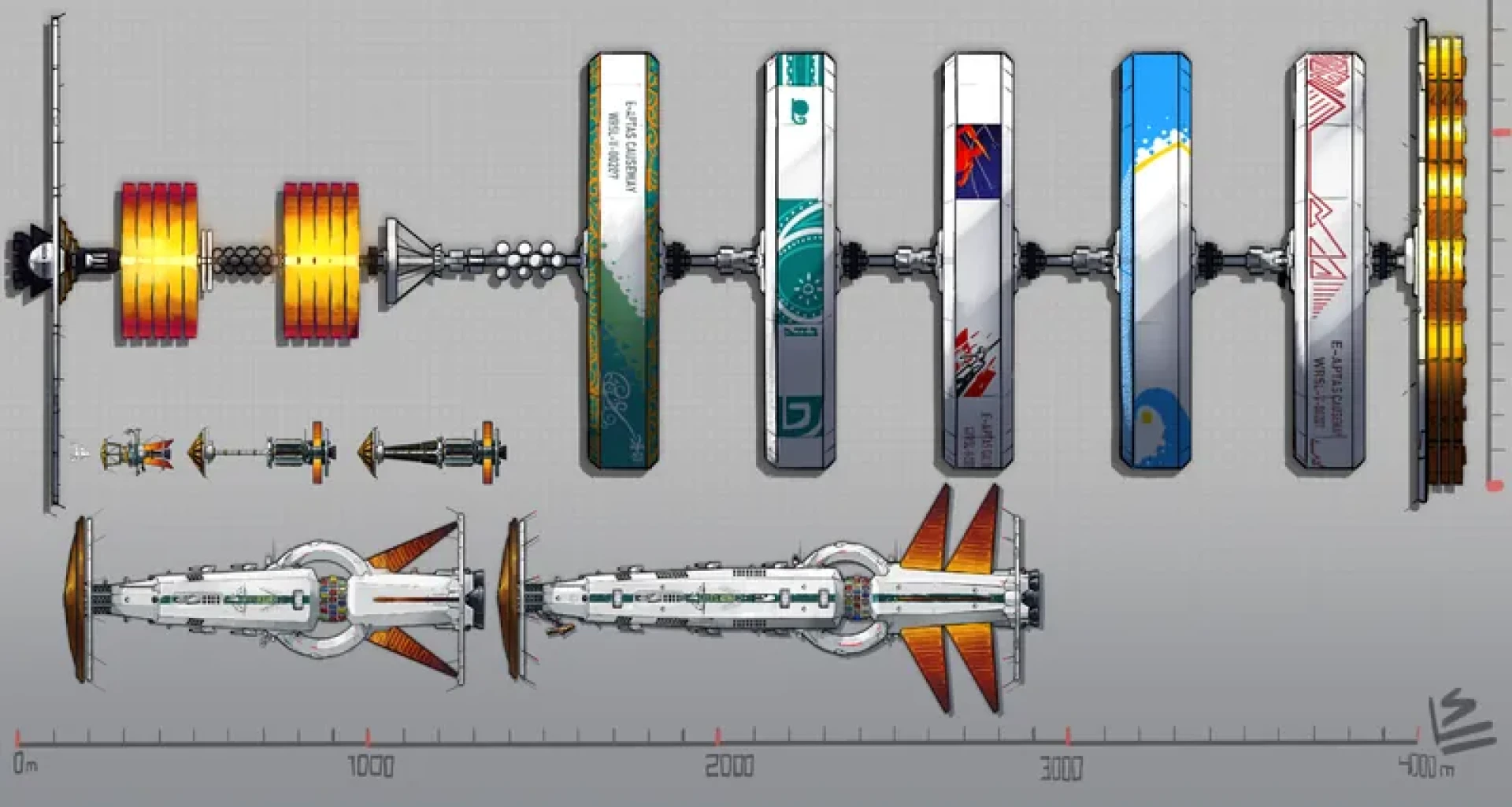
Jcb112 - WPAtaMS Art Reference and Lore Entry: Civilian Starships Part 1
 Up next
AgentRedGirl - [Trailer] Oopsie 04 - Steamed Weenies (Coming November 13th)
About This Title
Hello all, and welcome to the largest ship I’ve commissioned yet.
She’s a real chonky one, and indeed, larger than most classes of military vessels out there.
Which is to be expected, of course, given the vastly divergent design philosophies at play here between civilian and military domains.
A lot of consideration is given to quality of life measures that are typically absent from military vessels, and indeed, vessels just centuries prior to it.
In a similar vein to how cruise ships of the 21st century sport absolutely ridiculous amenities such as rock climbing walls, indoor waterparks, roller coasters, and even full-on botanical gardens, the interstellar liners of the 31st century likewise eclipse their forebears in just how extravagant their amenities can be. From entire sections of the habitation rings being dedicated to micro-climate conservatories and Olympic-sized swimming pools, to the size and sheer living space afforded to each passenger in their cabins and staterooms, the liners of the 31st century are a far cry from those first few tentative flights made by Jackie Setanta to Alpha Centauri. Indeed, her entire ship could comfortably fit inside one of those aforementioned indoor water parks. XD
So in the same way we like to joke that modern cruise ships are floating hotels compared to the ocean liners of old, so too have the 31st-century liners become something of a literal mobile space station compared to their sparse and spartan predecessors of yesteryear XD. Though, technically speaking, they aren’t anywhere near as superfluous as 21st-century cruise ships. Indeed, in spite of their lavish amenities, they actually have a lot more in common with those steamliners of old owing to the utilitarian function at their core — transporting people from point A to point B, not leisureboating for fun or recreation. It just so happens that they have a heck of a lot of amenities that make them functionally reminiscent of a cruise ship rather than an ocean liner.
All of which is to say, her size is a reflection of what a typical citizen would expect out of an interstellar voyage, and the vastly elevated minimum basic quality of life measured afforded to every citizen courtesy of the 2307 Protocols for the Minimum Acceptable Standard of Living (2307 P-MASL).
These measures have improved incrementally over time, as a means of ensuring an equitable distribution of cumulative production capacity and resource availability commensurate with that of the total industrial expansion curve and sustainable growth trajectory set out by policymakers and academics at the turn of each century and in review at each mid-century; both of which are reflected in the Century Development Goals (CDGs) and Mid-Century Development Amendments (MCDAs) respectively.
But yeah! What I’m trying to get at here is this: military vessels have to cram in and maximize their warfighting gear whilst balancing out all of the supporting equipment, systems, and on-board infrastructure as much as possible. All whilst trying to be as space-efficient as possible so as to limit their target profile by limiting their detectable cross-section as much as they can. And even with all that being said, the larger vessels still end up in the kilometer-range in terms of size. ;(
Civilian vessels, on the other hand, don’t have to bother themselves with such considerations. Their only real limitation is in the warp rings and associated warp bubbles they can generate, which again is only limited by their onboard power plants as well as their ability to sustain warp whilst in transit.
Thankfully, the hardest part about warp travel is the initial upfront investment in terms of power, as the generation of a warp bubble requires an immense upfront cost in terms of energy and the amount of time that energy has to be expended to achieve a stable warp bubble. Which is to say, a warp bubble can only be generated using a ludicrous burst of energy in a very short amount of time… something tantamount to an explosion in all but name. XD But I’m jesting here; whilst the amount of energy involved is very much reminiscent of the power expended in violent runaway explosive reactions, it’s all a very controlled process, really.
The main problem, however, is that containing that much energy and releasing it in that short of a time is… tricky.
Which is why antimatter capsules are used.
I’m unsure whether or not I mentioned this already, but antimatter capsules are needed for this upfront injection of energy as it’s the most energy-dense storage medium available, while also possessing an exceptionally high power delivery capacity and predictable energy release profiles capable of being tuned for each ship.
But yeah, I’m rambling again! XD
Let’s get back to the ship then!
So, another thing to note about warp is that collisions whilst a ship is underway in warp can be nothing short of catastrophic. We’ve discussed this before in the first ship post I did when I discussed the frontal impact shield of the cruiser and heavy cruisers.
The same thing applies here for these liners, of course, although that’s not the whole picture.
Whereas military ships must do what I call ‘bunny hopping’ — a procedure where the ships first scan the route in front of them for a trajectory where they’d be least likely to encounter space debris, before jumping, stopping short of that maximum projected route, then scanning again, before rinsing and repeating — civilian ships often don’t need to follow this procedure.
That’s because the path in front of them has been cleared of debris from one system to the next.
These are known as the interstellar transit corridors, or ITCs, and they’re something of a marvel of the modern world. However, unlike static objects, this marvel is less a feat of awe-inspiring structural or aerospace engineering, but rather a marvel of systems design and industrial engineering; a case where the emergent properties of the whole had become something far larger than the sum of its parts.
No single node along an ITC is truly remarkable. They’re the most robust, rugged, tried-and-true no-frills void station you can expect from something whose job it is to sit there in space scanning for potential hazards and deploying an on-board fleet of drones to deal with said hazards whenever detected.
Moreover, they also perform double-duty as signal-relay repeaters for the whole of humanity’s extranet network between star systems.
The thing here, however, is that while a single relay itself isn’t that impressive, it’s the fact that there are millions of them that make them truly remarkable.
Because these things form what is essentially a daisy chain that connects Earth to Alpha Centauri, and from Alpha Centauri to Luhman 16, Barnard’s Star, Tau Ceti, Epsilon Eridani, 40 Eridani, Sirius, and so on and so forth.
The entirety of human space is essentially daisy-chained together using this web of ITC relays, and it’s because of these relays that merchant shipping, passenger transport, and all manner of modern interstellar travel is possible without fear of the dangers posed by faster-than-light space travel.
But even so, modern liners are still equipped with frontal impact shields just in case.
But yeah! That’s the technical aspect of the ship out of the way for the most part, hmm…
Let’s talk about the ship itself then?
Starting perhaps first with its most striking design aspect — its rings.
These are the primary habitation areas of the ship, with each ring coming in at 200 meters in width, 100 meters in ‘height’ (the ‘thickness’ of the rings when measured from its exterior to its interior-most extent), and 1200 meters in diameter. This allows for a comfortable 1g worth of gravity to be generated at around 0.86 rotations per minute, which is well within the tolerable ranges for most of the general public. Indeed, it is these remarkably slow tangential velocities that make the whole trip a rather comfortable experience, especially compared with the smaller vessels of old, and most military vessels for that matter.
This is one of the main reasons — aside from sheer usefulness of all that space — why the ship is so large. It’s designed for comfort, safety, and reliability above everything else, at the cost of what most avid astronauts and pilots would refer to as the ‘gritty realities of spaceflight’.
Which, speaking of usable volume, we might as well discuss the passenger capacity! With well over 60 million cubic meters worth of space/volume for each ring, there’s plenty of carrying capacity to go around; this is especially true when considering that there are not one, but 10-15 decks to consider here. Following that, given how the ‘height’ of these rings is 100 meters, we’d have about 6 million square meters worth of total floor area to work with. However, as stated at the start of this whole ramble, the GUN’s not in the business of simply cramming people together like sardines back in the age of sail or even in the early days of space travel. Instead, in accordance with the P-MASLs, the smallest cabin on board the ship comes in at a comfortable 100 square meters worth of livable space. However, when accounting for other variables such as larger and more deluxe room sizes, public spaces, utility spaces, service areas, walkways, corridors, systems infrastructure, storage, amenities, private venues, etc, the actual rated passenger capacity works out to roughly 9000 passengers per ring.
This is because we’re taking into account that passenger cabins and suites take up just 30% of the available floor space, with the rest of that space going to the various utilities and public spaces I listed above. I’m also using an average of 200 square meters of room space per passenger, as 100 wouldn’t work because it’s the lowest common denominator here.
So yeah! Each ring works out to around 9000 - 10,000 passengers per ring, and if we were to go off of the larger 10,000 passengers per ring, that’d give this ship a PAX of 50,000! This isn’t accounting for crew, of course, but I digress XD
You’ll have to forgive my back-of-the-envelope calculations here; I don’t consider myself the most math-brained out there haha ^^;
But yeah! That’s it for the raw numbers bit.
Another thing to note here is the aesthetics of the ship itself. As you can see, despite its lavish and extravagant interiors, the actual structure of the ship is pretty basic, all things considered.
It’s effectively just 5 ring habitats attached to a spoke, which serves as the ship’s structural and engineering section. That’s where the actual ship functions are located, and as you can see, a ship of this size requires a rather absurd number of radiators and the accompanying systems to run them XD
Aside from that, we also have something cool and cultural to note here — the livery on the rings!
Each ring here pays homage to the various spacer constituencies whose workforce and production capacity contributed to its construction!
Moreover, the murals also come from a wide pool of artists from various backgrounds — whether that be a completely independent art studio, a state design bureau, a fashion house, a gaming studio, or even a completely unaffiliated self-taught artist. These artists and agencies either submit their proposals, or are directly commissioned by various design committees who then either deliberate internally, or outsource the vote to the public. It really depends on the particularities of the specific agency which operates the liner.
Which leads me cleanly into my next point!Who exactly operates these liners?
That’s a big question that has resulted in a lot of back-and-forths over the years.
Long story short, the main issue at play here is that FTL travel is in itself something of an existential threat. In that the very warp drives that allow for FTL travel are the same ones used in Kinetic Kill Weapons, which are at present the GUN’s single most destructive weapon of mass destruction.
So you can imagine the sorts of anxieties at play here when each ship is in effect a KKW lying in wait.
In summary, the only entities that operate FTL vessels outside of the military are the State’s transportation agencies and affiliated state enterprises; this includes State Owned Enterprises and the State Public Cooperatives. The latter two, however, whilst de facto 'operators' of certain merchant vessels and merchant vessel operations, are still heavily beholden to state control due to the security risks associated with the operation of an FTL-capable vessel. Thus, all 'purchases' or 'orders' of FTL capable vessels have to go through the GUN itself; it's important to note, though, that the purchasing process is more or less divided into two main contracts: the first one is the ownership of the vessel itself, which for SOEs and SPCs or even other semi-private entities means they own the vessel and everything associated with the vessel. The second, however, is the 'ownership' of the FTL drive and its associated systems. They don't necessarily 'own' the drive as it were; more so, they're 'leasing' the drive itself from a state entity with many clauses attached as to its operation, safety, and security oversight, with baked-in legal mechanisms to facilitate the aforementioned topics.
Anyways, sorry, I got carried away again.
So, when it comes to FTL capable civilian/merchant vessels. On the state side of things, you have two main administrations within the Department of Transportation:
1. The Exo-Atmospheric Passenger Transit Administration
2. The Exo-Atmospheric Cargo Transit Administration.
Or, as acronyms go, the E-APTA and the E-ECTA. Both of these administrations either directly operate their own passenger liners/cargo haulers, or operate them indirectly through State- Owned Enterprises and State Public Cooperatives such as the Space Transport Company (STC), North Star Lines (NSL), Public Interstellar Transportation Corporation (PITC), Public Interstellar Shipping Corporation (PISC), Sol-Centauri Friendship Group (S-CFG), Rockwell Interstellar Shipping Industries (RISI), Worlds’ Exchange Haulings and Logistics (WEHAUL), and the Interstellar Navigation Company (INC).
This particular ship, the Causeway, is one such vessel that’s operated directly by the Exo-Atmospheric Passenger Transit Administration, hence the prefix E-APTAS.
Alrighty, ok, that’s a lot of yapping.
But we’re not done.
We have to talk about the serial code and hull designation numbers on the side of the ship. Because that isn’t just a random string of numbers; I kind of also designed how that would work XD
WR5L - V - 00207
W - Warp Capability
R - Rotational Gravity
X - Number of Rings
L - Liner
V - This is a FUN one. This pertains to the ship’s ‘tonnage’/size. Or more specifically, what sort of dock the ship is capable of fully docking at, and what sort of drydock is capable of servicing it. With V being the ‘grade’ given to a class of ship known as the L-MAX series, or LUNAMAX as is its full designation.
There are only 2 grades above this, those being S-MAX and J-MAX, SATURNMAX and JOVIMAX respectively.
All of this reflects the maximum size of a ship capable of being constructed and serviced by the megafoundries of Luna, Saturn, and Jupiter, respectively.
I think that’s everything?
Yeah, I think that’s everything.
I feel winded after writing all of that haha.
I hope you enjoy the art!
I have to once again give my thanks to the artist, Sir_Lazz, for this piece. He once again knocked it out of the park, and I am forever grateful for his ability to create such a cohesive design language for the GUN’s ships!! :D
Artist Reference: Sir_Lazz from Bluesky

Comments (0)