
Page 1 failed to load.

EMPIRE REWRITTEN - Book III / Chapter 66: Under Whom?
 More from EMPIRE REWRITTEN
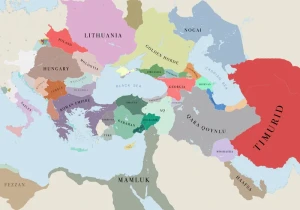
EMPIRE REWRITTEN - World map update
About This Title
Blachernae, early September 1441
Constantine was reading the new issue of the Kyrix on the balcony while he waited for George. The chessboard was already set out on a small table by the rail, with a copy of the Alexiad that Chortasmenos had given him lying at the end of it. Below him the Horn lay flat in the low sun. Farther down, the eagle had flown from the Tower of Galata since May.
Filelfo had given the battle the head of the sheet in large bold letters: “Triumph in Solkhat.” Below it, in smaller letters, came “How the Prince, with the Third Legion and the Guns of the Empire, Broke the Golden Horde on the Plain of Solkhat and Avenged the Dead of Avlita.” Under that the account ran for a column and a half, with General Kallistos named beside the Prince in the first sentence. By the second paragraph the horde was coming down on the Romans like locusts, and Constantine gave up on reading properly and skimmed the rest. Filelfo had many gifts. Restraint had never been one of them.
Lower down, the Tatar dead came to ten thousand, left on the plain for the crows. Somewhere between Solkhat and the press house, a great many more Tatars had died. Constantine smiled at that. Of the Romans the sheet said only that they had lost a couple of hundred dead and wounded.
George came out through the doors of the hall with his leather case under his arm and sat down across the board from him. He refused the wine with two fingers, as he did every evening. Then George opened the case on his knees and set three letters on the table beside the board.
Constantine had the white pieces. On his third move he brought his bishop out against George’s knight, the way he did in most of their games. George studied it for a long time before he answered with a pawn.
“I am told the Prince is saying in the City that he was owed a triumph,” George said.
Constantine moved a knight. “Who’s he saying it to?”
“To Izaoul, mostly. Izaoul says it to everyone else.”
“Then Izaoul will stop saying it,” Constantine said. “I will speak to them both at the hunt tomorrow.”
When the legion came home to the Kontoskalion in the last week of August, half the City had been on the new quays to watch it land. Thomas had come down the plank from the first transport with his helmet under his arm, and the noise along the quays had gone on until the last company was ashore.
“I told him the Kontoskalion was his triumph,” Constantine said.
“It seems he wanted the Golden Gate.”
Constantine turned the leaf on the table so that George could read the head of it. “Read that. It couldn’t be any grander if Thomas had written it himself.”
George read it and then went down the column to the numbers, as Constantine had. “Ten thousand,” he said. “Filelfo tells a battle the way old men tell one by the fire.” Then he took one of Constantine’s pawns.
Constantine won a pawn back with his knight. Behind the palace the bell for vespers began at the Chora, and down on the Horn a boat was crossing toward Galata with its sail half down.
George didn’t seem to mind about the pawn. He had Izaoul to talk about.
To give him his due, he was fair about it. He granted that Izaoul was a born envoy, the kind who could sit down with a bey or a Hungarian chancellor and have him talking freely within the hour. Constantine had seen him do it. But he was no good for the Prince, George said, and left it there.
George pushed a pawn up against Constantine’s bishop. “Someone has to go to Buda and to Burgundy before you give the Pope a number. Izaoul knows the road to Buda.”
“The Pope will send us his numbers,” Constantine said.
“The Pope’s numbers will be the Pope’s.”
Constantine moved his bishop back a square, out of reach of George’s pawns. “Then Izaoul can bring me Buda’s from Buda and the Duke’s from the Duke. When Bessarion comes he can write to Sforza for us. I’d like a soldier’s view as well as the Pope’s. I wonder how he’s doing in Naples.”
“Even fatter, I am told,” George said.
Constantine laughed. “Come out for the hunt with us tomorrow. Izaoul can hear about Buda there too.”
“Will Notaras be there? Is he still at you about the Crimea?”
Notaras had been at him about it since the legion came home. He wanted the judge’s seat in the north for the son of a friend, a young man whose father had commanded for Constantine’s father and who had come out of the law school in the spring with a good name. Constantine had told him he would think about it.
“He is,” Constantine said. “And the boy isn’t a bad choice. He did well at the law school. But we still have time. Captain Markos can manage up there for now.”
“I do not understand why you lean on Notaras and the Company so hard,” George said. “The north is quiet now. The crown paid for that war, and you would give the Company the trade it bought.”
“And who holds it for us when I bring the tagmata home?” Constantine said, without looking up from the board. “That region is a constant source of trouble. We had to send a full legion there, and for what? A few coastal towns, just to secure our trade, and three tagmata are still sitting in them. Now that it is quiet, let the Company take the place of the Genoese there. The crown cannot be invested everywhere. Notaras and his friends put their money in, and those men sail with the crusade.”
“Then Notaras will have his judge after all,” George said. He moved his queen out to the middle of the board. Then he took up the first of the three letters, which he had read at the chancery that afternoon.
It was the Commune’s second letter from Genoa and longer than the first. George gave the sense of it while Constantine looked at the board: the taking of Galata without notice under the ninth article, the paper the Podestà had been promised in May and never had, and the search of Caffa’s ships at the Straits, which the Commune called an insult to every Christian flag that passed there.
That was a bold thing to say for a city whose merchants had been shipping Christians to Alexandria until the spring. Constantine kept the thought to himself.
“They threaten nothing,” George said. “You did not make it easy for the Pope with Genoa, but it has worked well for us. Too well, I sometimes think.”
Constantine moved a knight up against George’s queen. It seemed a good moment to give George something else to think about.
“Genoa can’t afford a quarrel with us,” he said. “Not with the trouble it’s got at home. If they’re smart, they’ll swallow it. They can still trade in our ports, in everything but slaves.”
George moved his queen back out of the knight’s reach. It had all gone easily so far, he said, and he didn’t like it when a thing went as easily as Galata had.
The second letter was from Cesarini at Thessaloniki, saying that he was pleased with the council and its progress and that he would be in the City with Bessarion early in the next month, bringing what His Holiness had to say about ships and men.
“Then the cardinal is as pleased as Isidore,” George said.
“Mark isn’t,” Constantine said.
“The canon?”
“The Latins’ answer to it. They give the throne of this City second place after Rome, as the canon has it, and the Pope full power over the whole Church, in the manner set down by the councils and the canons. Isidore reads that as the councils keeping the Pope in bounds. The Latins read it as the councils agreeing with him. Mark wrote to me that a sentence two churches read two ways is not a union.”
George turned that over for a moment. “He is not wrong.”
“No. But in the East it will mean what we say it means, and Isidore will sign it. So will most of them.”
“Your father told John to keep the union on the table and never sign it,” George said. “He said it would leave us a worse schism than the one we have.”
“My father needed the Turks to be afraid of it. I don’t.”
“And the monks will read Mark.” George folded the letter.
Constantine pushed a pawn forward. “Then we give them something worth reading. The cardinal can bring me the Pope’s numbers, and an answer on Jerusalem with them. If his numbers are good, we’ll give him ours. Two legions and most of the fleet.”
George took the pawn with his queen. Then he picked up the last letter, the one that had come up from Cyprus. Podocataro wrote that the Mamluk Sultan had more galleys at Salines now than the fourteen that had lain there two winters before. Cypriot traders back from the Syrian ports said he was building more at Tripoli and Beirut, with timber brought down from the mountains. In Cairo he was said to be furious over Rhodes. This time he meant to finish it, and with it the Catalan corsairs who sailed out of the Knights’ harbor and took his ships.
“The Sultan will not wait for the Pope’s numbers,” George said.
“No,” Constantine said. “And this time we won’t hear of it too late.”
While George squared the letter’s corners, the first lamps were lit along the Galata shore across the water. Constantine picked up the Alexiad and opened it at the first page.
“Anna starts her father’s story with the Turks already in the East,” he said. “Romanos lost one battle at Manzikert, and in ten years they were at Nicaea.”
“That was nearly four hundred years ago.”
“And it took one battle, George. There was nothing behind the frontier, so when it broke, it broke all the way to the sea.” He closed the book and put it down by the board. “I’m not saying we go all the way back to Manzikert. But we need more country between the beys and our coast than we have now.”
“So that is what this is all about? A union with the Latins, to march them to Jerusalem?”
“The Pope dreams of taking back the Holy Land, and his dream serves us. The road to Jerusalem goes through Anatolia, the way it did for Alexios. In the end Anatolia has to be ours, even if some of it’s held for us by vassals.”
“Crusader states again?” George said. “Alexios had oaths from them too.”
He had, and Bohemond had sworn his as loudly as anyone and then kept Antioch. Constantine looked at the board for a while, and then across it at George.
“Imagine it, George. A union signed, and Jerusalem Christian again.”
“Under whom?”
Constantine didn’t reply. He moved his rook instead. It went down beside George’s king, where the bishop George had been looking at since the third move covered it, and the king had no square left to go to.
“You beat me at Ena,” Constantine said, “but I’m better at chess.”
George laid his king on its side. “Then you will teach me what you do with the bishop at the start.”
Constantine thought about it. He wasn’t sure he wanted to give it away.
Comments (0)