
Mike D'Angelo - Chronovisor (2026, Jack Auen & Kevin Walker)
infoAbout This Title
59/100
Looks 10, Dance 3 (where Looks = form and Dance = content). Let me first say that Chronovisor should be seen by any self-respecting cinephile—while I had a pretty good idea, 33 minutes into its 99, that I was gonna wind up mixed (for reasons addressed below), bailing never occurred to me. It's too singular for that. In fact, Auen and Walker might have made one of the few versions of...this...that I wouldn't love.
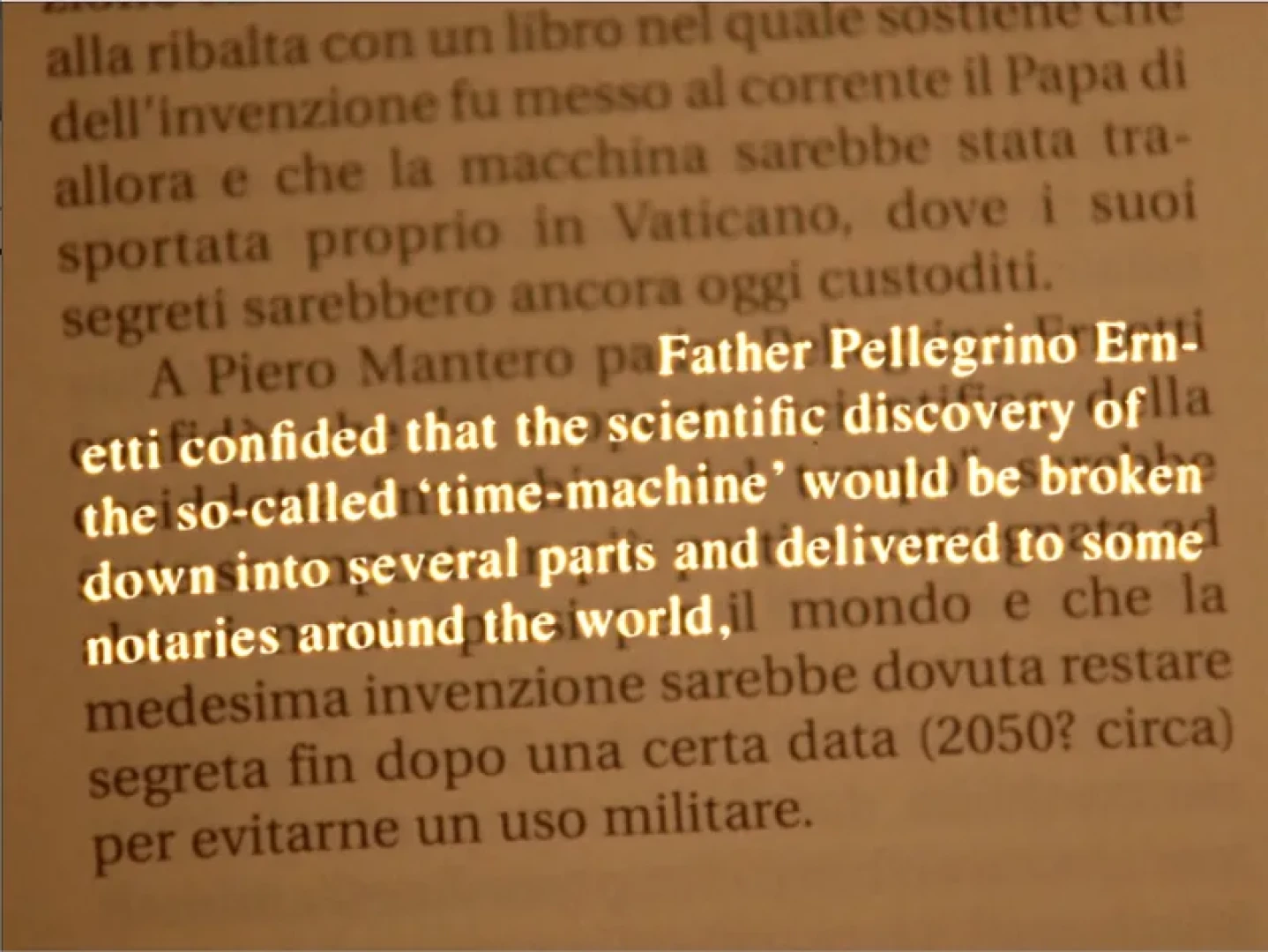
Here's the thing. I knew nothing going in. That's my deal, whenever possible. Very quickly, the film becomes a sustained research project. We watch a scholar (embodied by real-life academic Anne-Laure Sellier, though she's not playing herself; the character's name is Beatrice) sitting in various dimly lit libraries and archives, paging through decades-old materials. I'd estimate that close-ups of book and magazine pages take up nearly half of Chronovisor's runtime, and you're expected to read and digest the passages in question—it's always clear which passages, because English translations are superimposed directly over the relevant lines (and the same happens even when the original text is in English, though that's rarely). Some would surely argue that a movie you're very frequently obliged to read is the opposite of cinematic, but it really doesn't feel that way at all, thanks to a combination of murky 16mm atmosphere, judicious editing (with cuts to Beatrice's face as she peruses, along with her environment), that omnipresent overlaid text effect, and highly dramatic musical accompaniment that I'll get to in just a moment. I found myself mesmerized, at least for a while. Especially since the subject of her dogged research isn't dry specialized arcana but a rumored paranormal device (see title) that allegedly transmitted images from ancient history, including "live" footage of Christ's crucifixion.
However. Maybe 15 or 20 minutes into the picture, the sheer quantity and verisimilitude of archival material began to seem logistically unfeasible for what I'd just assumed to be a Borges-adjacent esoteric tall tale. Much of the text is French, and I read French well enough to recognize that the translations are all legit—this isn't the written equivalent of someone subtitling Hitler's Downfall rant with comically unrelated dialogue. Nor did anything remotely look AI-generated. And creating all of it from scratch would take a couple of indie filmmakers like 10 years and cost them maybe $500K. Perhaps that's an exaggeration, but so many absolutely perfect (in both format and apparent age) mock-ups seemed damn near impossible. "This has to be real," I thought. And indeed it is. Chronovisor isn't exactly a documentary—Sellier examined all that stuff only because the script and/or the directors instructed her to—but neither can it properly be categorized as fiction. It's apparently sort of re-creating Auen and Walker's own tumble down the rabbit hole after they stumbled onto a reference to the chronovisor, concluding with an invented avant-garde twist (which reminded me scientific efforts to reconstruct sounds/images from brainwave activity).
The problem with realizing that the chronovisor is real—or, rather, that the lore surrounding it is real—is that the chronovisor is dumb. In fact, I would bet significant cash money that the Italian Benedictine monk Pellegrino Ernetti, who claimed to have used the chronovisor around 1972 (and who's the primary subject of Beatrice's research), had read Isaac Asimov's 1956 short story "The Dead Past," which I'm almost positive I've mentioned in some previous review, though which one escapes me and Patreon's search engine is no help. "The Dead Past" features a device called the chronoscope that functions identically to the chronovisor, and it winds up being suppressed by the government for the exact same reason that Ernetti once gave for the chronovisor's mysterious disappearance (in text that we see onscreen): Since viewing someone a millisecond in the past effectively allows you to surveil them in real time, such technology could readily be abused and must never be made public. (In the short story, our ostensible hero finally succeeds in widely disseminating the specs, thinking himself a revolutionary, and learns only afterward that in fact he's ended any notion of privacy for everyone on Earth. Like most Asimov, it's not well written, but it's very clever.) So that kinda dampened my present-tense interest in what's being related by history (though not in the presentation of same), and Beatrice's opacity as a character didn't help. Obviously, a device that can transmit images from centuries ago is absurd on its face, and at no point does any of the research material suggest even a quasi-plausible sci-fi explanation of how it could work. Proffered examples—an image of Jesus on the cross (that looks like the statue it is); lines from a Greek play long considered lost—are immediately debunked. Is Beatrice intent on finding the chronovisor because she believes it might be genuine? That seems unlikely, but so does expending so much time and effort on an obvious hoax. Her motivation remains unknown, and while the ending provides an answer of sorts, that didn't retroactively erase my frustration.
Also—and this is not by any means their "fault"—Auen and Walker chose Holst's grandiosely stirring The Planets to accompany their archival sequences, and while that choice works beautifully, Milagros Mumenthaler happened to beat them to the punch, orchestrating my single favorite scene released so far this calendar year to "Venus, the Bringer of Peace." Heard again so soon, it just didn't have the intended force.
Still, if I had to save the only copy of this film or, say, The Sheep Detectives (which I liked a little more at 62/100), the decision would not be terribly hard. If you dig unconventional cinema, it's a must-see.
59/100
Looks 10, Dance 3 (where Looks = form and Dance = content). Let me first say that Chronovisor should be seen by any self-respecting cinephile—while I had a pretty good idea, 33 minutes into its 99, that I was gonna wind up mixed (for reasons addressed below), bailing never occurred to me. It's too singular for that. In fact, Auen and Walker might have made one of the few versions of...this...that I wouldn't love.
Here's the thing. I knew nothing going in. That's my deal, whenever possible. Very quickly, the film becomes a sustained research project. We watch a scholar (embodied by real-life academic Anne-Laure Sellier, though she's not playing herself; the character's name is Beatrice) sitting in various dimly lit libraries and archives, paging through decades-old materials. I'd estimate that close-ups of book and magazine pages take up nearly half of Chronovisor's runtime, and you're expected to read and digest the passages in question—it's always clear which passages, because English translations are superimposed directly over the relevant lines (and the same happens even when the original text is in English, though that's rarely). Some would surely argue that a movie you're very frequently obliged to read is the opposite of cinematic, but it really doesn't feel that way at all, thanks to a combination of murky 16mm atmosphere, judicious editing (with cuts to Beatrice's face as she peruses, along with her environment), that omnipresent overlaid text effect, and highly dramatic musical accompaniment that I'll get to in just a moment. I found myself mesmerized, at least for a while. Especially since the subject of her dogged research isn't dry specialized arcana but a rumored paranormal device (see title) that allegedly transmitted images from ancient history, including "live" footage of Christ's crucifixion.
However. Maybe 15 or 20 minutes into the picture, the sheer quantity and verisimilitude of archival material began to seem logistically unfeasible for what I'd just assumed to be a Borges-adjacent esoteric tall tale. Much of the text is French, and I read French well enough to recognize that the translations are all legit—this isn't the written equivalent of someone subtitling Hitler's Downfall rant with comically unrelated dialogue. Nor did anything remotely look AI-generated. And creating all of it from scratch would take a couple of indie filmmakers like 10 years and cost them maybe $500K. Perhaps that's an exaggeration, but so many absolutely perfect (in both format and apparent age) mock-ups seemed damn near impossible. "This has to be real," I thought. And indeed it is. Chronovisor isn't exactly a documentary—Sellier examined all that stuff only because the script and/or the directors instructed her to—but neither can it properly be categorized as fiction. It's apparently sort of re-creating Auen and Walker's own tumble down the rabbit hole after they stumbled onto a reference to the chronovisor, concluding with an invented avant-garde twist (which reminded me scientific efforts to reconstruct sounds/images from brainwave activity).
The problem with realizing that the chronovisor is real—or, rather, that the lore surrounding it is real—is that the chronovisor is dumb. In fact, I would bet significant cash money that the Italian Benedictine monk Pellegrino Ernetti, who claimed to have used the chronovisor around 1972 (and who's the primary subject of Beatrice's research), had read Isaac Asimov's 1956 short story "The Dead Past," which I'm almost positive I've mentioned in some previous review, though which one escapes me and Patreon's search engine is no help. "The Dead Past" features a device called the chronoscope that functions identically to the chronovisor, and it winds up being suppressed by the government for the exact same reason that Ernetti once gave for the chronovisor's mysterious disappearance (in text that we see onscreen): Since viewing someone a millisecond in the past effectively allows you to surveil them in real time, such technology could readily be abused and must never be made public. (In the short story, our ostensible hero finally succeeds in widely disseminating the specs, thinking himself a revolutionary, and learns only afterward that in fact he's ended any notion of privacy for everyone on Earth. Like most Asimov, it's not well written, but it's very clever.) So that kinda dampened my present-tense interest in what's being related by history (though not in the presentation of same), and Beatrice's opacity as a character didn't help. Obviously, a device that can transmit images from centuries ago is absurd on its face, and at no point does any of the research material suggest even a quasi-plausible sci-fi explanation of how it could work. Proffered examples—an image of Jesus on the cross (that looks like the statue it is); lines from a Greek play long considered lost—are immediately debunked. Is Beatrice intent on finding the chronovisor because she believes it might be genuine? That seems unlikely, but so does expending so much time and effort on an obvious hoax. Her motivation remains unknown, and while the ending provides an answer of sorts, that didn't retroactively erase my frustration.
Also—and this is not by any means their "fault"—Auen and Walker chose Holst's grandiosely stirring The Planets to accompany their archival sequences, and while that choice works beautifully, Milagros Mumenthaler happened to beat them to the punch, orchestrating my single favorite scene released so far this calendar year to "Venus, the Bringer of Peace." Heard again so soon, it just didn't have the intended force.
Still, if I had to save the only copy of this film or, say, The Sheep Detectives (which I liked a little more at 62/100), the decision would not be terribly hard. If you dig unconventional cinema, it's a must-see.

Comments (0)