
Page 1 failed to load.
Mike D'Angelo - TIFF 2026: Day Seven (plus a straggler)
 More from Mike D'Angelo
Mike D'Angelo - The Texas Chain Saw (Chainsaw) Massacre (2)
About This Title
Hastily written at the airport! [UPDATE: And now continuing on the plane.]
La bola negra (Javier Calvo & Javier Ambrossi, Spain/France): 52
Netflix should release this as Blackballed!, which is more in keeping with its aggressively energetic tenor. Basic idea’s solid, speculating about an unfinished story or novel (changed to a play here, for some reason) by Federico García Lorca: One storyline dramatizes that, complete with invented conclusion (cue grave-rolling); another thread, set during the Spanish Civil War, follows a coward who joins the Nationalists to save his skin and falls for García Lorca’s real-life lover, Rafael Rodríguez Rapún; and then in I think it’s 2017 an ostensibly random dude (who turns out to have a link to someone named above) believes he may have found La bola negra’s missing pages. These tales unfold simultaneously, with constant cross-cutting over some 159 minutes, and only the wartime one really justifies all the breathless attention afforded to it; I could have done with 75% less of the present-ish day stuff, little of which is germane to the whole apart from seeking to ensure that all three timelines foreground queerness. Glenn Close and Penélope Cruz show up in cameos to negligible effect, with the latter more recognizable to me vocally than facially. It’s fairly Netflix-y.
Spring in a Small Town (1948, Fei Mu): 65
Pretty sure it’s been 25 years since I watched a classic at TIFF, but (a) there were no enticing contemporary options around that time, (b) tickets were readily available, and, most important, (c) this was one of only two films in the current They Shoot Pictures top 200 that I hadn’t yet seen. (Only Dovzhenko’s Earth now remains. Sorry, no link to the list because airport; you’ll have to google it.) While I wasn’t blown away myself, that’s probably due at least in part to a certain familiarity stemming from all the great bittersweet romances it’s influenced over the past eight decades, most notably In the Mood for Love. (Maggie Cheung was clearly styled in that film to resemble Wei Wei in this one.) Formally dazzling at times—there are some truly breathtaking Expressionistic nighttime shadows—but also a bit too eager to spell out its characters’ emotions via poetic voiceover narration. Though I can potentially see myself accepting that aspect, too, as bold stylization, should I give this another look at some point. Certainly it’s far superior to my admittedly dim memory of Tian Zhuangzhuang’s 2002 remake (which I gave 42/100 at the time). I can see why it’s revered.
Minotaur (Andreï Zviaguintsev [sic, that’s what’s onscreen], France/Germany/Latvia): 61
Saw beforehand and then totally forgot that this is Chabrol’s La Femme infidèle, which is still in my to-watch queue. Narrative and atmosphere have been thoroughly Zvyagintsevved, though, and I once again (as with Leviathan) found myself slightly resisting a first-rate portrait of institutional corruption, simply because it feels reflexively easy (even if true) to suggest that people can get away with any imaginable horror provided they’re allied with the national power structure. Where Minotaur diverges from its source, it does so in exactly the way that you’d expect from this filmmaker, and I correctly guessed where we were headed despite not knowing said source at all. (Well, I did see Lyne’s Unfaithful. But I barely remember that. Didn’t like it, 49/100.) Still, it’s totally engrossing moment-to-moment, anchored by a lead performance that positively oozes fatal weakness of character counterbalanced by (accurately) perceived untouchability. It’s just also the kind of film in which you know what a banner being torn down will consist of at least 30 seconds before its face is shown to you.
Double Freedom (Lisandro Alonso, Argentina/Chile/Germany/UK/Luxembourg): 24
Went back to the hotel and rewatched La libertad between Spring for a Small Town and Minotaur; will address that in September’s Quibi post, but suffice to say that I was significantly more receptive this time (gave it a D– in 2001), if still a long way from persuaded that it’s terribly interesting. Even in that improved frame of mind, however, this quarter-century-later sequel seemed no more necessary or rewarding than Book of Shadows: Blair Witch 2. Sure, it’s a little haunting to see La libertad’s woodcutter in middle age, performing the same physical labor at a marginally slower pace. But Double Freedom (drives me nuts that NYFF didn’t call the original Freedom and isn’t calling this one La libertad doble) spends half of its expanded running time (71 minutes has become 100) repeating shots from the 2001 version (though I’d wager that average shot length has nearly doubled—having watched the two nearly back-to-back, I noted much less rhythmic variety in the sequel, with Alonso more inclined just to set the camera up at a medium distance and let it run for 4-5 minutes) and the other half introducing a plot element that I’d now argue damages the project’s conceptual purity by introducing pathos where none should be welcome. In short: bad idea. Be sure to stay through the entire closing credits, however, as there’s a truly delightful cookie.
That concludes Day Seven, but I had time for one film this morning, and it was a winner.
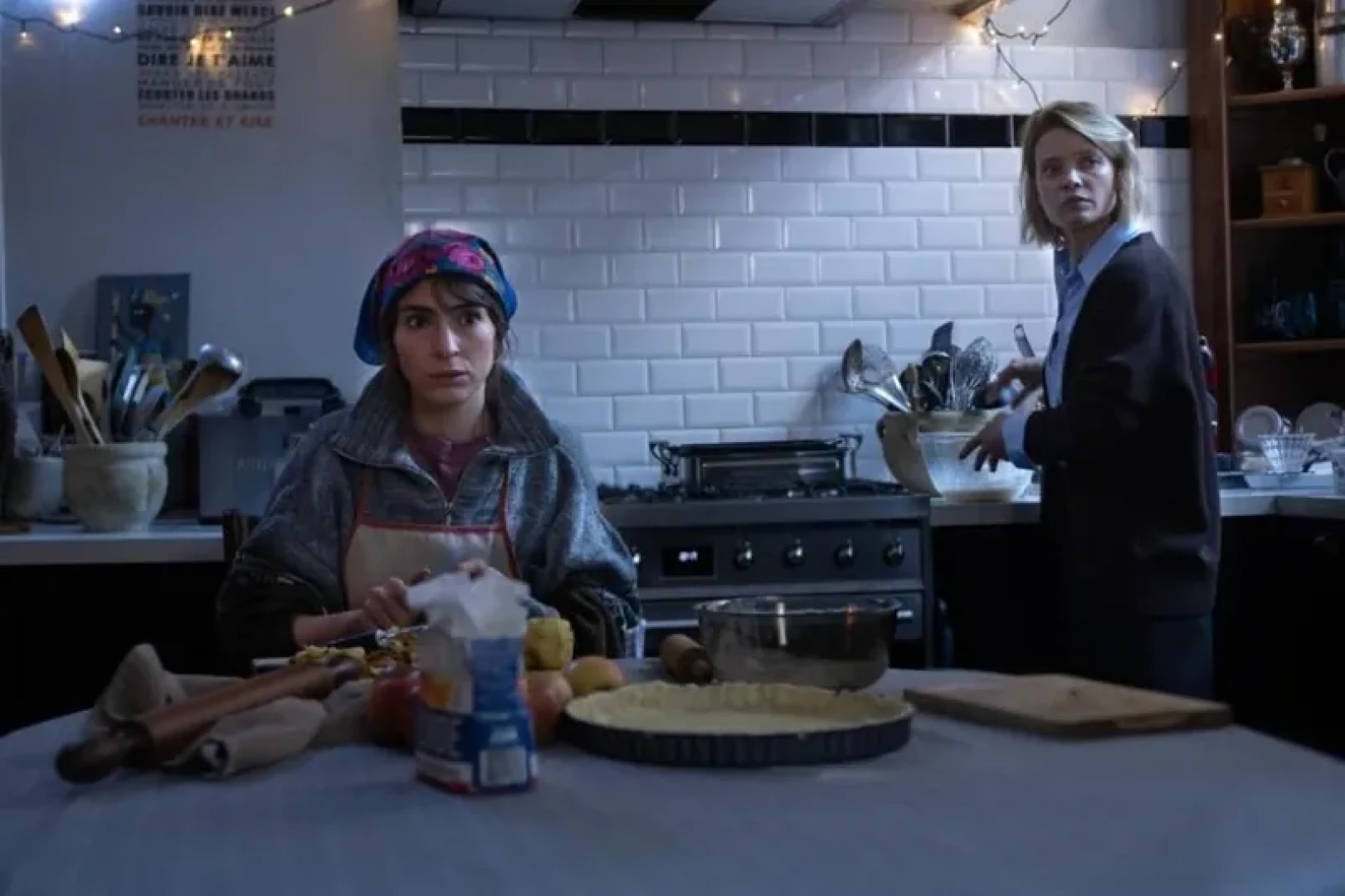
The Diary of a Chambermaid (Radu Jude, France/Romania): 68
Have seen the Buñuel (which I didn’t much like, 45/100), not yet the Renoir. But this here is the Jude, which means that it’s not a straight or even crooked adaptation of Mirbeau’s novel but a very contemporary meditation on same in which the chambermaid (stellar newcomer-to-me Ana Dumitrașcu), when not slaving for a wealthy, kind-up-to-a-point French couple, is playing the title role in a black-box college production of Chambermaid, despite having no experience as an actor nor any particular desire to be one. (She was recommended by her employers—Mélanie Thierry and Vincent Macaigne are both note-perfect, totally oblivious to their selfishness but often affectionate with Gianina and never actually rude or disdainful; the film ends on an act of viciousness doubling as generosity that you’ve barely had time to process when the end credits roll.) If you’ve seen any previous film about a woman taking professional care of someone else’s kid while separated from her own out of financial necessity (I’m specifically recalling Walter Salles & Daniela Thomas’ superb Paris je t’aime short, but there are other examples, I think), this isn’t doing anything dramatically different, which is the main reason I’m not even higher on it. Packs a wallop, though. Glad to see he’s still finding small, spiky roles for Ilinca Manolache, who gets to briefly do male “drag” again.
C’est tout! Only 27 films (31 if you count the four I bailed on), which is a record low for me, but that was inevitable when I booked the flight home for Thursday instead of Monday. Not sure whether I’ll ever do the complete fest again, honestly—press screenings peter out even earlier than they used to, and public tickets have become a nightmare, so sticking around for the final weekend seems a bit quixotic. Once again, we’ll see how I feel around 10 months from now.
Posted this on Bluesky earlier, but my top five (TIFF ‘26 peaked early for me):
The Unknown (Arthur Harari) [79]
Bucking Fastard (Werner Herzog) [75]
The Diary of a Chambermaid (Radu Jude) [68]
Tender Loving Care (Mike Leigh) [66]
The Debut (Jesse Eisenberg) [63]

Comments (0)