
Page 1 failed to load.
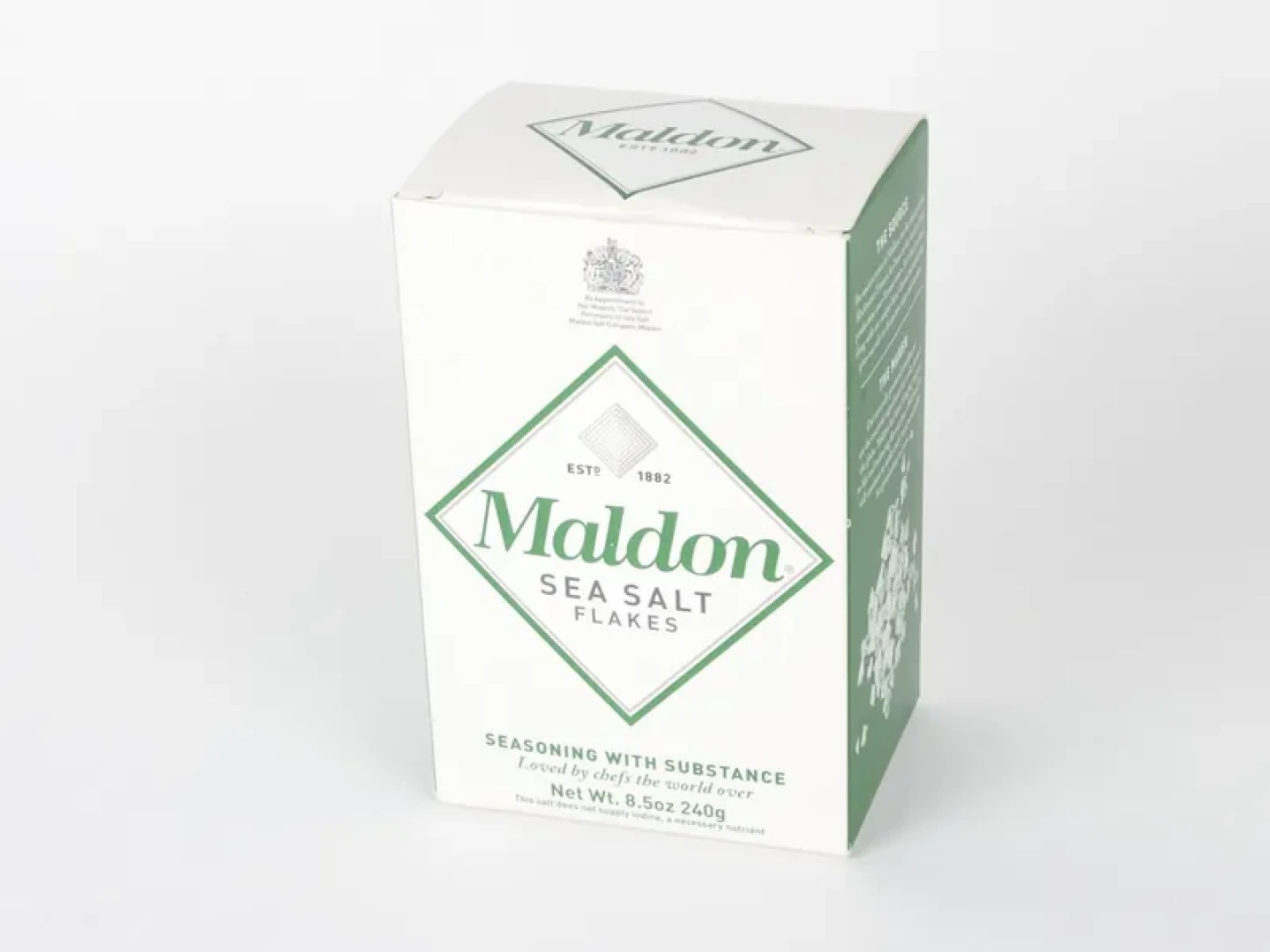
James Kenji Lopez-Alt - Why I’ll Keep Using Maldon Salt.
 More from James Kenji Lopez-Alt
James Kenji Lopez-Alt - An Easy White Bean Pot Pie for Special Nights or Every Night
About This Title
There’s been some controversy recently surrounding the provenance of Maldon salt that I wanted to weigh in on from a food writer’s perspective.
The pyramid-shaped salt crystals, harvested at the same estuary in Essex for over a hundred years—or so the company says—have been beloved by chefs for decades. I’ve personally used Maldon as a finishing salt for nearly three decade because of its uniquely large, pyramid-shaped flakes and the texture and bursts of salinity it brings when finishing foods.
Here’s the news: a recent investigative report in the Observer found that the Maldon company has been importing thousands of pounds of rock salt from Germany to use in its manufacturing process, calling into question whether the company has been dishonest with the claims of its salt originating in Essex.
There are three interesting questions here for me, and here they are in order of importance:
1. Did they mislead the public?
2. Have they lied about their product?
3. Should we, as home cooks and chefs, care?
I want to take the time to quickly talk about all three of these questions, offering some opinions. But first, it’s important to understand exactly what salt is, and what makes one salt different from another.
What is Salt?Chemically speaking, the salts we use to season our food are all sodium chloride, or NaCl. Whether it comes from an underground deposit in Pakistan, a salt pond in Brittany, or an estuary in Essex, it’s the same old universally-consistent (literally!) sodium and chloride ions arranged in a repeating crystalline lattice. Importantly, once that salt is dissolved in water and those ions separate and disperse, the sodium chloride itself retains no memory of where it was from—it is identical in every way.
Of course, the stuff you buy isn’t always just pure sodium chloride. Depending on where it was harvested and how it’s processed, salt can contain varying amounts of moisture, other minerals, and added ingredients. Those differences can be visible. Himalayan pink salt gets its color from iron oxide and other impurities. Sel gris from France picks up its gray color from the clay in the ponds where it’s harvested. Hawaiian black lava salt is colored with active charcoal.
Clearly, these products aren’t chemically identical—we can see the difference in them.
But being able to see a difference doesn’t necessarily mean you can taste it.
This is a question food writers and scientists have been poking at for decades. I first came across it in Jeffrey Steingarten’s 2002 essay collection, It Must’ve Been Something I Ate, in an article called “Salt Chic,” in which he found that the differences in salts once dissolved into solution were minimal, and nearly undetectable in foods. In a 2010 study, researches found that the answer is a little bit more subtle, confirming that impurities in high quantities can affect the way we perceive saltiness with salt dissolved in a water solution, particularly in how fast that salty sensation spreads or lingers. (That study did not address those effects in food.)
So the question is not whether we can perceive impurities in salts—there’s evidence that says we can. The real question is whether there’s enough of those impurities present in any particular salt to matter. With most culinary salts, these compounds make up a tiny fraction of something we’re already adding a tiny amount of.
For perspective, the stuff that makes Himalayan pink salt pink is its .004% iron oxide content. So if we’re using that salt to season a pot of soup at 1% of that soup’s weight, the added iron oxides from the pink salt make up only .00004% of the dish. This is a dilution level completely undetectable by humans by sight, aroma, or taste.
There are exceptions. Some gray sea salts have calcium or magnesium content high enough to reach a detectible threshold in strong solutions, giving them a detectible bitterness, but again, its mineral content rarely hits that detectible threshold in the quantities we generally use when seasoning foods.
Other salts—such as the pure white crystalline pyramids Maldon is known for—contain less than 1% total Non-NaCl minerals, and none of those minerals come in large enough quantities to be detectible in food.
So if it’s not the chemicals, what makes different sea salts so special? Why do chefs care?
Sea the Difference?It all comes down to shape and size. See, large-grained sea salts are not typically used during cooking, they’re used when finishing a dish, just before serving, where their large, undissolved crystals can actually make a material culinary difference.
Depending on exactly how the crystals are formed and harvested, the same sodium chloride can form compact cubes, coarse irregular grains, thin flakes, or delicate hollow pyramids. These aren’t different chemical versions of salt, they’re simply different ways of putting the same salt molecules together in a crystal lattice. Under certain growth conditions, for instance, the edges of a crystal grow faster than its faces can fill in, producing hollow, stepped pyramids known as hopper crystals—the type of crystal Maldon is known for.
The shape of those crystals depends not on the provenance of the salt, but on the conditions under which the crystals grow: how concentrated the brine is, how quickly water evaporates, how salt moves through the liquid to reach the growing crystal, the shape and size of the evaporation chamber, etc. In some cases, sunshine, wind, temperature, and humidity can affect the way outdoor salt ponds produce crystals. In heated pans, the producer has more control over the consistency. Brine composition can also affect growth, but the important part is that a particular crystal shape isn’t an inherent property of salt from a particular location.
For a cook selecting a finishing salt, these physical differences matter enormously. They determine how easily you can pick salt up and distribute it, how much fits into a teaspoon, and how it crunches and dissolves as you bite into it. In some cases, it can even affect flavor.
Take, for instance, those moist, gray sea salts, like gros sel de Guérande or a Celtic gray salt. Sprinkling a dish with them just before serving will not only add crunch and salinity, but a detectible note of bitterness. Why? It’s because the high calcium and magnesium contents provided by the clay water beds those salts are harvested from reaches detectible thresholds as those grains transform a super-concentrated brine as they dissolve on your tongue.
With most other salts, however, those extra flavors are not part of the equation. Instead, a snowy shite salt like fleur de sel or those wonderfully flaky crystals from Jacobsen’s are adding only two (very important) things: bursts of clean salinity, and texture.
So when it comes down to it where the salt initially came from makes no meaningful difference on the finished product. Once dissolved into brine—as all sea salt is—sodium chloride from one source is indistinguishable from sodium chloride from another. The only parts that make a difference in the finished product are the specifics of production—what extra minerals are being introduced as the brine evaporates, and how the crystals are being formed and harvested.
Want an extreme example? The snowy white crystals of fleur de sel, with its clean, pure salinity and delicate flakiness is made from the exact same water as the coarse gray crystals of sel gris. In fact, they are made in the exact same evaporation ponds as part of the exact same process. The only difference is that the delicate fleur de sel crystals are carefully skimmed off the tops of the briny pools as they form through evaporation, while the sel gris is the salt that is allowed to sink to the bottom, where it picks up minerals from clay.
It’s the same water, the same evaporation pools, and even two parts of the same process, but the end results are about as different as two finishing salts can get.
Now that we’ve established exactly what matters—and what doesn’t—when it comes to salt, let’s talk about the Maldon scandal.
Did they mislead the public?There’s no question here. The public has felt mislead, whether that was intentional or not. It may be naive to think that a company that produces and distributes salt at the scale that Maldon does can possibly harvest all of its salt from a single small estuary in England, but they certainly have not made a effort to dispel the misconception.
Moreover, when a company builds its identity around a particular location, emphasizes generations of local salt makers, and sells a product labeled “sea salt,” I think it’s reasonable—however far-fetched—for customers to assume that the salt in the box comes from that location. Imported rock salt is a significant detail to leave out of that story.
Maldon’s own response is that rock salt comes from ancient seas, and that dissolving it into seawater before recrystallizing it is part of its longstanding production method. This is all completely true. Maldon themselves had been sourcing rock salt mined and imported from other parts of England to produce their flakes long before the German salt scandal broke, and they weren’t secretive about it.
That said, there’s a pretty substantial difference between what a geologist means by an ancient sea, what a salt manufacturer means by “hand harvested in Essex” and what a customer understands when they read “sea salt” on a box decorated with a story about the Essex coast.
And while the finished product may have remained unchanged through all of these changes in salt sourcing, that doesn’t make the omission irrelevant. People make purchasing choices for all kinds of reasons beyond functionality, the story and provenance of an ingredients being one of them. A company doesn’t get to decide that those things don’t matter just because its customers can’t taste the difference.
Could Maldon have told the whole story?
Sure. Try this:
“The unique shape and fine texture of Maldon salt comes from a centuries-old harvesting process perfected through generations of salt makers. It transforms sea salt and rock salt into the delicate pyramids beloved by chefs the world over.”
Or something like that. That’s a perfectly respectable way to make salt. I’d rather they had trusted their customers with it.
That said:
Have they lied about their product?I do not believe they have lied about their product. Their website and marketing materials makes claims about how the salt is still produced using the same manufacturing process they started over a century ago. It also claims that the production and harvest all occur at their facility at an estuary in Essex, England. Does it imply that salt comes directly from Essex? It depends on how how closely you read it, but I’d argue no, they never make that claim.
But there’s another question underneath it: have we been buying an inferior product dressed up as something special?
I don’t see evidence of that either.
The imported rock salt is dissolved into the brine before the finished flakes are formed, where it is no longer distinguishable in any way from any other salt dissolved in the same water.
Maldon’s own description emphasizes the control of temperature, time, and movement needed to produce its pyramid crystals. Whatever you think of the sourcing, there is a manufacturing process that turns dissolved salt into a product with particular physical qualities, and that is the thing that makes Maldon salt so sought-after. It has nothing to do with where the salt originated, and everything to do with how it is handled.
Personally, those qualities are the qualities I’ve been paying for. I love the size of the flakes and how they can stay whole and large, or how I can crumble them between my fingers. I like the delicate crunch and the little bursts of salinity they give a finished dish. Learning where some of the sodium chloride originated doesn’t retroactively make those experiences imaginary, nor does it affect my personal relationship with the product.
Nor does this revelation, by itself, establish that the salt has changed in any way. There’s been no noticeable difference in the crystals as far as I’ve seen—further evidence that salt provenance is not important for the quality of this particular product—and if the manufacturing process is identical, there’s no reason to think that the crystals should change in any way.
The story on the box may have given customers the wrong impression, but the flakes inside it still have the qualities that I bought them for.
Should we, as home cooks and chefs, care?We should care about being told the truth, but how that affects what we buy is a personal decision.
If you are someone who bought Maldon specifically because you believed all of its salt came from the Blackwater Estuary, then maybe this reporting gives you a reason to reconsider, though I imagine the number of folks buying Maldon for that specific reason are vanishingly small. If you feel that the company’s explanation falls short, you don’t need to prove that the salt tastes worse to take your business elsewhere.
For me, the reason I started using Maldon—and the reason I’ve continued using it for nearly three decades—is how it behaves on food and nothing in this reporting changes what I like about that. I’m also happy to pay for the work involved in making those flakes. The value of a finished ingredient isn’t limited to the cost or rarity of its raw materials. Producing a consistent texture that cooks enjoy using is worth something, even when the starting material is ordinary sodium chloride.
So I’ll keep using Maldon. I’d also like Maldon to be more straightforward about its production and sourcing—more knowledge is always a good thing, and despite the romantic story of all my salt coming from a single British estuary, I’m just fine with the story being no deeper than a really great product produced in a time-honored way, which is exactly what Maldon continues to be.

Comments (0)