
Page 1 failed to load.
James Kenji Lopez-Alt - A Warm and Koji Thanksgiving: For Better Mashed Sweet Potatoes, add Miso and Time
 More from James Kenji Lopez-Alt
James Kenji Lopez-Alt - An Easy White Bean Pot Pie for Special Nights or Every Night
About This Title
There are very few savory dishes that can’t be either improved or at least successfully modified with the addition of some good ol’ Aspergillus oryzae (A.K.A. koji spores) or one of its offspring, soy sauce and miso paste, and these miso brown-butter mashed potatoes are a case in point.
But first: do you want to know the secret to the densest, sweetest, most flavorful sweet potatoes? It’s not a secret ingredient and it’s not a fancy technique. All it takes is a bit of time.
Come to think of it, it’s not even really a secret. Heck, I myself have written about the technique multiple times and have made a couple of videos explaining it all in the past.
Want to skip straight to the good stuff? Here’s the basic TL;DR:
Roast your sweet potato in the oven very, very slowly. The slower you roast it, the sweeter it will become. And this is not some trick of the senses or anything to do with moisture loss or changes in density. Slow-roasting a sweet potato alters its structure on a molecular level, converting starches into the sweet disaccharide maltose. The resulting sweet potatoes are dense and creamy, with an almost toffee-like complexity to them.
Once you’ve got those extra-sweet and tender roasted sweet potatoes, you have the basis for the most incredibly delicious mashed sweet potatoes. In my original recipe, I finish the sweet potatoes with plenty of brown butter to add a nutty toastiness to it. These days I up the umami as well by stirring in a few tablespoons of miso paste as the butter browns.
Want more details? Read on.
Take Your Sweet TimeFor this recipe, we’re starting with a high moisture, red-fleshed sweet potato variety like Garnet, Jewel, or Beauregard sweet potatoes. (Garnets are sometimes sold as “yams” in certain markets—a botanical misnomer, as true yams are a different vegetable altogether.)
A raw sweet potato contains sugars, but it also contains a substantial supply of starch—a larger molecule made up of simpler sugars linked into long chains. The problem is that in that linked-up form, the molecules become too large to register as sweet. Our tongues simply don’t recognize them.
You can think of them as a group of toddlers trying to sneak their way into a matinee showing of the R-rated social parody classic, RoboCop. When they sit on each other’s shoulders and throw a trench coat over themselves, they successfully hide their identity. But! Knock that stack of kids over and let them tumble out of their trench coat, and they reveal themselves for the sweet little creatures they are.
So how do we convert those starch molecules into sugars that our tongues can detect? Lucky for us, sweet potatoes come equipped with the firepower to do it themselves. Sweet potatoes contain a starch-digesting enzyme called beta-amylase which, given time, will convert starch into maltose, a disaccharide made up of two glucose molecules.
Our job is simple: Optimize the conditions for that beta-amylase to do its work.
Harold McGee described this method in his kitchen science manual, On Food and Cooking: “Moist sweet potato varieties sweeten during cooking thanks to the action of an enzyme that attacks starch and breaks it down. The enzyme starts to make maltose when the tightly packed starch granules absorb moisture and expand, beginning at around 135°F, and it stops when the rising heat denatures it, at around 170°F.”
That gives us a useful working range of about 135 to 170°F (57 to 77°C). As the starch granules take up water and swell, their starch becomes easier for the enzymes to attack. As the temperature rises, those enzymes begin to work overtime, converting starches ever more rapidly until they eventually break down as they hit that upper 170°F range.
To test the efficacy of this enzyme, I ran a series of tests using a water bath to hold slices of sweet potato at 150°F for various lengths of time, ranging from one hour to 24 hours. At that temperature range, a sweet potato will not even begin to soften—that doesn’t happen until around 183°F, the temperature at which the pectin glue holding vegetable cells together will begin to break down—so for all intents and purposes, the sweet potato slices that were held hot were virtually indistinguishable from fresh sweet potato slices by appearance.
Roasting them side by side, however, told a different story.
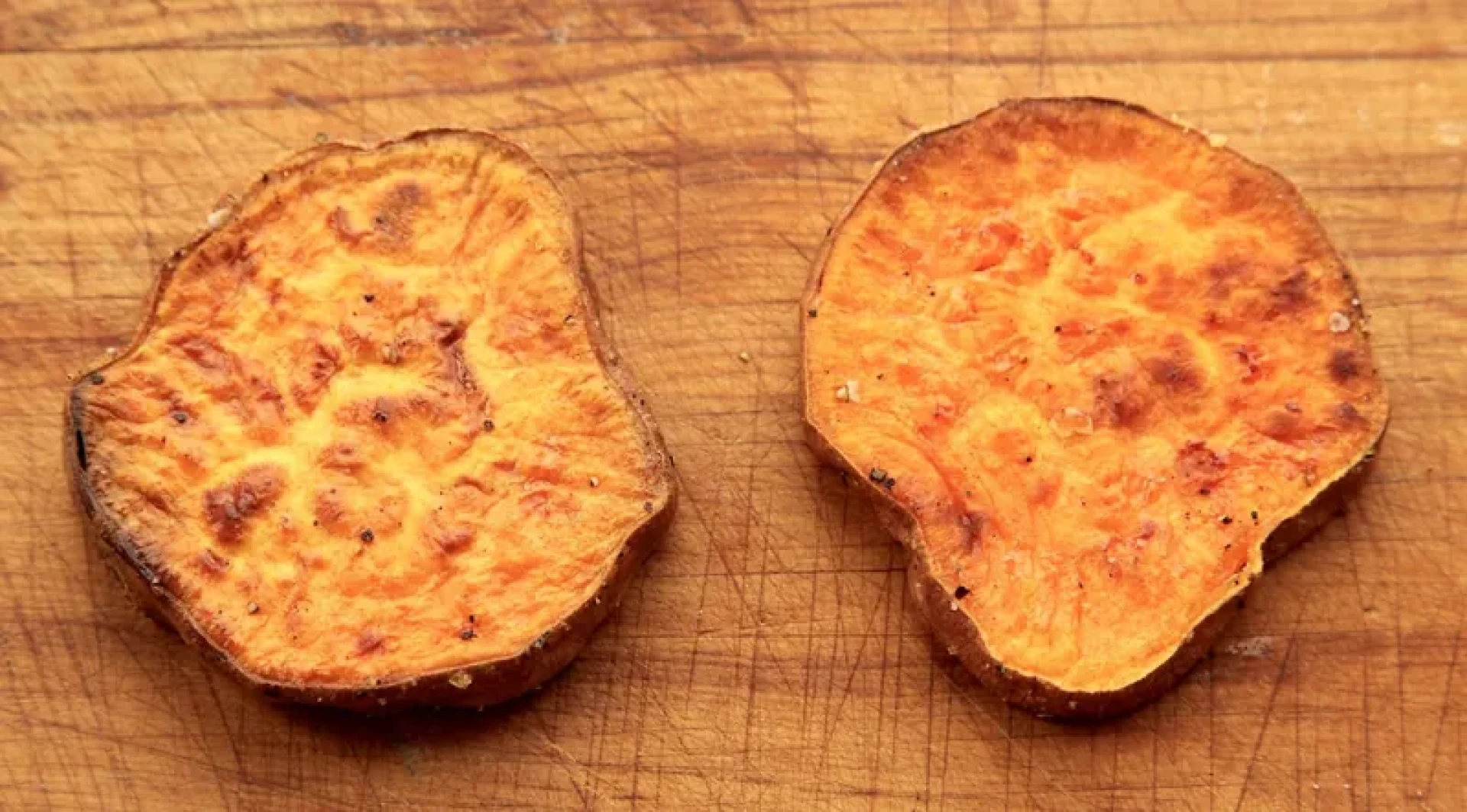
You can see the results here:
The sweet potato on the left was left in a water bath at 150°F for 12 hours, while the one on the right was sliced and roasted fresh. While the fresh sweet potato had a brighter orange appearance, the water bath-treated sweet potato browned significantly faster—an indication that it contained a higher proportion of more reactive simple sugars.
Tasting them side by side also revealed that the water bath-treated sweet potato was noticeably sweeter and more custardy in texture.
Further testing over the years has shown me that the exact amount of sweetening will vary from sweet potato to sweet potato, but the practical takeaway is straightforward: the more time the sweet potato spends in that 135 to 170°F range, the sweeter it will become, although the greatest benefits happen within the first hour or two.
Slow and Steady Wins the RoastThe sous vide method works especially when the eventual goal is browned pieces with crisp edges—like in my roasted sweet potato recipe. But for a bowl of mashed sweet potatoes, I like to get the sweetening and the cooking done in one fell swoop in the oven.
There are a couple approaches to this. One of them is to slow roast whole sweet potatoes in a foil pouch. The pouch holds moisture around the potatoes and keeps their surfaces from drying out and getting as hot as they can in an uncovered roast. Combined with a low oven temperature (300°F or even lower, depending on home time you have) in order to maximize the time the sweet potato spends under that 170°F threshold, it produces evenly cooked, dense, sweet flesh and skins that slip off easily.
The other option is to peel and cut the potatoes into chunks and slow-roast them in a covered braiser. Starting the potatoes in a cold oven adds another opportunity to slow their warming. Whether you use a foil pouch or a covered braiser, you have the opportunity to add some aromatics—whole thyme, sage, or rosemary sprigs work well here.
Brown Butter and Miso Meets its MashIn my original mashed sweet potato recipe, I stir in some browned butter as I mash them, which gives them a nutty flavor that reinforces their toffee-like sweetness and complexity.
More recently, I’ve started adding a few tablespoons of miso paste to my butter off-heat just as it reaches the shade of brown I’m after, which adds some umami depth that plays very nicely off the potatoes’ natural sweetness. White and brown miso both work. White miso generally gives a milder, sweeter result, while darker brown miso tends to contribute a more pronounced fermented flavor. Saltiness can vary quite a bit between styles and brands, so make sure to wait until your miso-brown butter mixture is combined with the potatoes before tasting and adjusting the seasoning with more salt.
My original mash also included a small amount of maple syrup to accentuate its caramel-like flavor. The slow roast supplies plenty of sweetness on its own, so taste this version before deciding whether you want any.
A Mash Made in HeavenWith the potatoes slow-roasted and the miso brown butter made, finishing is just a matter of mashing the sweet potatoes and butter together, adding a little warm milk or cream to loosen it to the consistency you want.
For chunky potatoes, use a masher. For lighter whipped sweet potatoes, use the whip attachment on a stand mixer. And for a velvety smooth puree, pull out your food processor.
The finished potatoes should be creamy enough to sweep up with a fork with the nutty complexity of miso, the nuttiness of brown butter, and the complex sweetness of a slow-roasted sweet potato all coming through. The cooking takes a while, but by the time dinner is ready, most of the work is already behind you. All that’s left is scraping the good brown bits out of the pan.
Recipe: Mashed Sweet Potatoes With Miso Brown ButterEvery recipe I publish here is personally tested, tasted, and approved.
What I love about this recipe:Slow-roasting gives the sweet potatoes’ own enzymes time to turn starch into sugar, bringing out their natural sweetness.
Brown butter reinforces their toffee-like flavor, while white miso adds a savory depth that balances it all out.
Cooking peeled chunks in a covered braiser means there are no hot skins to deal with, and most of the cooking time is hands-off.
Yield: Serves 6 to 8
Active Time: 25 minutes
Total Time: About 2 to 3 hours
Notes:
Use moist, orange-fleshed sweet potatoes such as Garnet, Jewel, or Beauregard. Cooking time will vary with your oven, braiser, and the size of the chunks; the potatoes should offer almost no resistance when pierced.
White miso varies in saltiness, so wait until the potatoes and miso butter are combined before adding salt.
For a chunky mash, use a potato masher; for a lighter, whipped texture, use a stand mixer; for a smooth purée, use a food processor.
IngredientsFor the Sweet Potatoes:
3 pounds (1.4 kg) orange-fleshed sweet potatoes, peeled and cut into 2-inch chunks
2 or 3 sprigs fresh thyme, 1 small sprig rosemary, or 3 fresh sage leaves (optional)
1 tablespoon (15 ml) vegetable or olive oil
½ cup (120 ml) whole milk or heavy cream, warmed, plus more as needed
Kosher salt
Maple syrup, to taste (optional)
For the Miso Brown Butter:
6 tablespoons (85 g) unsalted butter
2 tablespoons (about 35 g) white miso
MethodSlow-roast the sweet potatoes. Place the sweet potatoes in a braiser large enough to hold them in a shallow layer. Tuck in the herbs, drizzle with olive oil, and cover with a tight fitting lid or foil. Transfer to the middle rack of a cold oven and set the oven to 300°F (150°C). Cook until a fork or thin knife slides through the largest pieces with almost no resistance, about 1 ½ to 2 ½ hours from turning on the oven. Start checking after 1 hours. If the pan looks dry and the potatoes are sticking before they are tender, add a small splash of water, cover, and continue cooking.
Make the miso brown butter. Meanwhile, melt the butter in a small saucepan or skillet over medium heat, preferably one with a light-colored interior (this makes it easier to see how brown the butter is getting). Cook, swirling the pan constantly and scraping the bottom with a heatproof spatula, until the milk solids are golden brown and the butter smells nutty. Remove from the heat and immediately stir in the white miso until thoroughly combined. (The mixture may sputter.)
Mash the potatoes. When the potatoes are cooked, remove and discard the herb stems and any whole leaves. Transfer the potatoes to a mixing bowl, stand mixer, or food processor, along with any liquid that has pooled in the pan. Add the miso brown butter, scraping in all the browned bits, and mash, whip, or process to your desired texture.
Adjust and serve. Mix in the warm milk or cream a little at a time, adding only as much as needed to reach your preferred consistency. Season to taste with salt and a little maple syrup, if you’d like additional sweetness. Serve hot.
See All Thanksgiving Recipes Here on PatreonThere are very few savory dishes that can’t be either improved or at least successfully modified with the addition of some good ol’ Aspergillus oryzae (A.K.A. koji spores) or one of its offspring, soy sauce and miso paste, and these miso brown-butter mashed potatoes are a case in point.
But first: do you want to know the secret to the densest, sweetest, most flavorful sweet potatoes? It’s not a secret ingredient and it’s not a fancy technique. All it takes is a bit of time.
Come to think of it, it’s not even really a secret. Heck, I myself have written about the technique multiple times and have made a couple of videos explaining it all in the past.
Want to skip straight to the good stuff? Here’s the basic TL;DR:
Roast your sweet potato in the oven very, very slowly. The slower you roast it, the sweeter it will become. And this is not some trick of the senses or anything to do with moisture loss or changes in density. Slow-roasting a sweet potato alters its structure on a molecular level, converting starches into the sweet disaccharide maltose. The resulting sweet potatoes are dense and creamy, with an almost toffee-like complexity to them.
Once you’ve got those extra-sweet and tender roasted sweet potatoes, you have the basis for the most incredibly delicious mashed sweet potatoes. In my original recipe, I finish the sweet potatoes with plenty of brown butter to add a nutty toastiness to it. These days I up the umami as well by stirring in a few tablespoons of miso paste as the butter browns.
Want more details? Read on.
Take Your Sweet TimeFor this recipe, we’re starting with a high moisture, red-fleshed sweet potato variety like Garnet, Jewel, or Beauregard sweet potatoes. (Garnets are sometimes sold as “yams” in certain markets—a botanical misnomer, as true yams are a different vegetable altogether.)
A raw sweet potato contains sugars, but it also contains a substantial supply of starch—a larger molecule made up of simpler sugars linked into long chains. The problem is that in that linked-up form, the molecules become too large to register as sweet. Our tongues simply don’t recognize them.
You can think of them as a group of toddlers trying to sneak their way into a matinee showing of the R-rated social parody classic, RoboCop. When they sit on each other’s shoulders and throw a trench coat over themselves, they successfully hide their identity. But! Knock that stack of kids over and let them tumble out of their trench coat, and they reveal themselves for the sweet little creatures they are.
So how do we convert those starch molecules into sugars that our tongues can detect? Lucky for us, sweet potatoes come equipped with the firepower to do it themselves. Sweet potatoes contain a starch-digesting enzyme called beta-amylase which, given time, will convert starch into maltose, a disaccharide made up of two glucose molecules.
Our job is simple: Optimize the conditions for that beta-amylase to do its work.
Harold McGee described this method in his kitchen science manual, On Food and Cooking: “Moist sweet potato varieties sweeten during cooking thanks to the action of an enzyme that attacks starch and breaks it down. The enzyme starts to make maltose when the tightly packed starch granules absorb moisture and expand, beginning at around 135°F, and it stops when the rising heat denatures it, at around 170°F.”
That gives us a useful working range of about 135 to 170°F (57 to 77°C). As the starch granules take up water and swell, their starch becomes easier for the enzymes to attack. As the temperature rises, those enzymes begin to work overtime, converting starches ever more rapidly until they eventually break down as they hit that upper 170°F range.
To test the efficacy of this enzyme, I ran a series of tests using a water bath to hold slices of sweet potato at 150°F for various lengths of time, ranging from one hour to 24 hours. At that temperature range, a sweet potato will not even begin to soften—that doesn’t happen until around 183°F, the temperature at which the pectin glue holding vegetable cells together will begin to break down—so for all intents and purposes, the sweet potato slices that were held hot were virtually indistinguishable from fresh sweet potato slices by appearance.
Roasting them side by side, however, told a different story.
You can see the results here:
The sweet potato on the left was left in a water bath at 150°F for 12 hours, while the one on the right was sliced and roasted fresh. While the fresh sweet potato had a brighter orange appearance, the water bath-treated sweet potato browned significantly faster—an indication that it contained a higher proportion of more reactive simple sugars.
Tasting them side by side also revealed that the water bath-treated sweet potato was noticeably sweeter and more custardy in texture.
Further testing over the years has shown me that the exact amount of sweetening will vary from sweet potato to sweet potato, but the practical takeaway is straightforward: the more time the sweet potato spends in that 135 to 170°F range, the sweeter it will become, although the greatest benefits happen within the first hour or two.
Slow and Steady Wins the RoastThe sous vide method works especially when the eventual goal is browned pieces with crisp edges—like in my roasted sweet potato recipe. But for a bowl of mashed sweet potatoes, I like to get the sweetening and the cooking done in one fell swoop in the oven.
There are a couple approaches to this. One of them is to slow roast whole sweet potatoes in a foil pouch. The pouch holds moisture around the potatoes and keeps their surfaces from drying out and getting as hot as they can in an uncovered roast. Combined with a low oven temperature (300°F or even lower, depending on home time you have) in order to maximize the time the sweet potato spends under that 170°F threshold, it produces evenly cooked, dense, sweet flesh and skins that slip off easily.
The other option is to peel and cut the potatoes into chunks and slow-roast them in a covered braiser. Starting the potatoes in a cold oven adds another opportunity to slow their warming. Whether you use a foil pouch or a covered braiser, you have the opportunity to add some aromatics—whole thyme, sage, or rosemary sprigs work well here.
Brown Butter and Miso Meets its MashIn my original mashed sweet potato recipe, I stir in some browned butter as I mash them, which gives them a nutty flavor that reinforces their toffee-like sweetness and complexity.
More recently, I’ve started adding a few tablespoons of miso paste to my butter off-heat just as it reaches the shade of brown I’m after, which adds some umami depth that plays very nicely off the potatoes’ natural sweetness. White and brown miso both work. White miso generally gives a milder, sweeter result, while darker brown miso tends to contribute a more pronounced fermented flavor. Saltiness can vary quite a bit between styles and brands, so make sure to wait until your miso-brown butter mixture is combined with the potatoes before tasting and adjusting the seasoning with more salt.
My original mash also included a small amount of maple syrup to accentuate its caramel-like flavor. The slow roast supplies plenty of sweetness on its own, so taste this version before deciding whether you want any.
A Mash Made in HeavenWith the potatoes slow-roasted and the miso brown butter made, finishing is just a matter of mashing the sweet potatoes and butter together, adding a little warm milk or cream to loosen it to the consistency you want.
For chunky potatoes, use a masher. For lighter whipped sweet potatoes, use the whip attachment on a stand mixer. And for a velvety smooth puree, pull out your food processor.
The finished potatoes should be creamy enough to sweep up with a fork with the nutty complexity of miso, the nuttiness of brown butter, and the complex sweetness of a slow-roasted sweet potato all coming through. The cooking takes a while, but by the time dinner is ready, most of the work is already behind you. All that’s left is scraping the good brown bits out of the pan.
Recipe: Mashed Sweet Potatoes With Miso Brown ButterEvery recipe I publish here is personally tested, tasted, and approved.
What I love about this recipe:Slow-roasting gives the sweet potatoes’ own enzymes time to turn starch into sugar, bringing out their natural sweetness.
Brown butter reinforces their toffee-like flavor, while white miso adds a savory depth that balances it all out.
Cooking peeled chunks in a covered braiser means there are no hot skins to deal with, and most of the cooking time is hands-off.
Yield: Serves 6 to 8
Active Time: 25 minutes
Total Time: About 2 to 3 hours
Notes:
Use moist, orange-fleshed sweet potatoes such as Garnet, Jewel, or Beauregard. Cooking time will vary with your oven, braiser, and the size of the chunks; the potatoes should offer almost no resistance when pierced.
White miso varies in saltiness, so wait until the potatoes and miso butter are combined before adding salt.
For a chunky mash, use a potato masher; for a lighter, whipped texture, use a stand mixer; for a smooth purée, use a food processor.
IngredientsFor the Sweet Potatoes:
3 pounds (1.4 kg) orange-fleshed sweet potatoes, peeled and cut into 2-inch chunks
2 or 3 sprigs fresh thyme, 1 small sprig rosemary, or 3 fresh sage leaves (optional)
1 tablespoon (15 ml) vegetable or olive oil
½ cup (120 ml) whole milk or heavy cream, warmed, plus more as needed
Kosher salt
Maple syrup, to taste (optional)
For the Miso Brown Butter:
6 tablespoons (85 g) unsalted butter
2 tablespoons (about 35 g) white miso
MethodSlow-roast the sweet potatoes. Place the sweet potatoes in a braiser large enough to hold them in a shallow layer. Tuck in the herbs, drizzle with olive oil, and cover with a tight fitting lid or foil. Transfer to the middle rack of a cold oven and set the oven to 300°F (150°C). Cook until a fork or thin knife slides through the largest pieces with almost no resistance, about 1 ½ to 2 ½ hours from turning on the oven. Start checking after 1 hours. If the pan looks dry and the potatoes are sticking before they are tender, add a small splash of water, cover, and continue cooking.
Make the miso brown butter. Meanwhile, melt the butter in a small saucepan or skillet over medium heat, preferably one with a light-colored interior (this makes it easier to see how brown the butter is getting). Cook, swirling the pan constantly and scraping the bottom with a heatproof spatula, until the milk solids are golden brown and the butter smells nutty. Remove from the heat and immediately stir in the white miso until thoroughly combined. (The mixture may sputter.)
Mash the potatoes. When the potatoes are cooked, remove and discard the herb stems and any whole leaves. Transfer the potatoes to a mixing bowl, stand mixer, or food processor, along with any liquid that has pooled in the pan. Add the miso brown butter, scraping in all the browned bits, and mash, whip, or process to your desired texture.
Adjust and serve. Mix in the warm milk or cream a little at a time, adding only as much as needed to reach your preferred consistency. Season to taste with salt and a little maple syrup, if you’d like additional sweetness. Serve hot.
See All Thanksgiving Recipes Here on Patreon
Comments (0)