
Page 1 failed to load.

Didrik Magnus-Andresen - The Forgotten Child on the Throne
 More from Didrik Magnus-Andresen
Didrik Magnus-Andresen - Once we ran
About This Title
The Forgotten Child on the Throne
After the disappearance of Zaruven Zar-Šūren, the throne of Hurriaä did not stand empty.
It was occupied by a child.
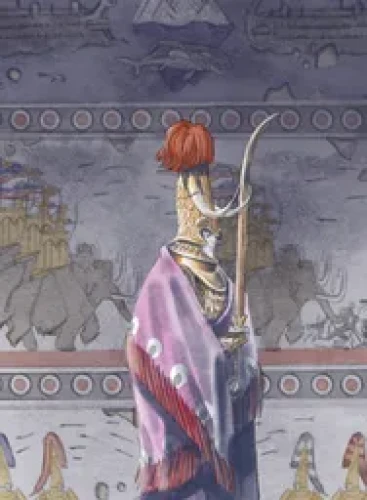
Tirāša Nāthu-Zarûn, the Once-Seen, Daughter of the Unpermitted, was crowned while still young—too young to rule, too dangerous to ignore, too sacred to discard. Her coronation was not an act of hope, but of containment. The realm needed a symbol, and she was all that remained of the serpent bloodline.
Power did not sit with her. Instead it gathered around her as councils ruled in her name. Regents governed through her seal. Priests invoked her lineage while ensuring she was never present. Over time, she became less a queen than a problem deferred—remembered only when legitimacy was needed, and otherwise kept unseen, uneducated, and politically irrelevant.
She was sought not as a ruler, but as a bride. To marry her was to inherit the throne, to control her was to claim the serpent’s shadow.
The Fracturing of the Realm
With the dread King Zaruven gone and the devastation he named unity still raw in the flesh of the world, unity proved impossible.
The throne of Hurriaä remained occupied in name, yet empty in truth, for the child who sat upon it remained unseen and unheard, while power gathered elsewhere, in councils, war camps, and the ambitions of elves who had survived the Zaruven, and believed that survival itself marked them as chosen.
Within a generation, the realm splintered into three great kingdoms, each proclaiming itself the rightful heir of Tenehu.
Each claimed continuity. Each claimed necessity. Each claimed the blood of the Serpent. For in the absence of a strong king upon the jade throne in Hurriaä, lineage itself became the sharpest weapon of all.
Across the land arose pretenders, prophets, and warlords who declared themselves lost sons of Zaruven, descendants of the Cursing King, or sovereign by some other right. Some bore marks upon their flesh as proof. Some displayed relics. Others needed only the belief of their followers and the fear of their enemies.
Few were ever proven false yet none were proven true.
The Northern Kingdom
The first to break away was the North.
Built upon the highlands and the newly exposed coasts, the northern realm was harsh, proud, and difficult to govern. Its rulers sat in stone keeps overlooking fjords, pineclad forests and mountain passes, far from the rituals and scrutiny of Hurriaä. Distance itself became their shield.
The North produced more Serpent-Claimants than any other land yet it did not endure.
Isolation bred ambition, and ambition bred fracture. Succession disputes were constant, for every ruler left behind rivals who claimed equal or greater right. Kingdoms shattered into lesser states, then into petty realms, then, some into warbands led by elves who styled themselves kings with no land but what their spears could reach.
Some of these northern domains were later swallowed by the Central Kingdom for a short while. Others were erased entirely—remembered only by ruins, broken temples , and names scratched into stone by hands that expected no future.
The Central Kingdom — Hurriaä
Hurriaä endured as the symbolic heart of the realm.
It controlled the plains, the river basin, and the last remnants of imperial infrastructure. It possessed the throne, the rites of coronation, the ledgers of lineage, and the priesthoods that still remembered how power was once sanctified.
Most importantly, it possessed the child queen.
She was rarely seen. Rarely spoken of. Brought forth only when legitimacy was required—her name sealed decrees, her presence invoked during oaths, her bloodline cited in treaties she would never read.
This kingdom claimed continuity, yet others called it stagnation.
Within Hurriaä, rule passed between regents, councils, and rival factions. Assassination was more common than battle. Marriage was a battlefield of its own. All warred for the hand of Tirāša, yet her consent was never required, and her new husband never lasted long beside her. At times, the city seemed ruled by no one at all, united only by precedent and fear.
And yet, all who claimed the serpent blood measured themselves against Hurriaä, for without the throne, no claim could ever be complete.
The Southern Kingdom
The southern realm was wealthier, more populous, and more openly defiant than any other land of Tenehu.
Its kings rebuilt swiftly after the Cursing, raising new cities atop older ruins and reclaiming the fertile valleys beyond the Serpent Spine. Great canals were dug, forests cleared, and broad fields of wheat once more covered the southern valleys. Trade returned sooner here than elsewhere, bringing bronze, wealth, and ambition. The southern lords grew powerful, and many came to see Hurriaä not as their sacred center, but as a fading relic clinging to old authority.
They rejected the rule of the crowned child and the scheming regents who governed in her name.
Instead the south increasingly turned toward older and more dangerous traditions. Ancient claims of divine favor resurfaced, and many came to believe that strength alone marked the favor of the gods.
Thus war with the Central Kingdom became constant.
Not wars of conquest, but long and grinding struggles of raids, sieges, and shifting alliances. Armies marched endlessly through the mountain passes, while borderlands were burned and rebuilt so often that some villages changed allegiance more times than their elders could remember.
Victory was rare, and a defeat was never final.
Turikalsa
The Age of Endless War
Thus began in earnest the Turikalsa, the Breaking of Thrones—an age not marked by a single cataclysmic war, but by ceaseless violence without resolution or end.
The Central and Southern kingdoms bled one another dry in campaigns that achieved nothing but exhaustion. Armies marched, withdrew, and marched again over the same ground until the soil itself seemed to remember their passing. Kings rose only to fall within a handful of years, some within a single season—killed in battle, betrayed by allies, poisoned at their own tables, or quietly erased from the records by those who followed. Claimants of serpent blood appeared with ominous regularity, proclaiming themselves lost sons of Zaruven or heirs to secrets no one could verify, and vanished just as swiftly, leaving behind only rumors and shallow graves.
Alliances shifted with the years, sometimes with the seasons. Oaths sworn beneath banners were broken before the tablet had been been fired in kilns. Cities were rebuilt atop their own ashes, only to be burned again when the tide of war inevitably returned. Even Hurriaä, the heart of what remained of the realm, knew no true stability. Power passed from hand to hand through regencies, courtly intrigue, sanctioned murders, and quiet coups that left no trace but a sudden change in whose seal marked the clay.
There were emperors in all but name, ruling lands too fractured to be called empires. There were kings whose reigns lasted no longer than a summer. There were rulers whose existence is known only from a single coin pulled from the mud, a half-burned charter, or a curse carved into a wall by hands that expected no witness.
It was a time when history could not keep pace with reality, when events moved faster than memory. Scribes learned to leave blank spaces where names should have been, knowing that to record them would be a waste of time—and perhaps an invitation to share their fate.
The End of the Turikalsa
The wars did not end in victory.
They ended in exhaustion.
The Southern Kingdom fractured into smaller states, then into raider domains, then into nothing at all beyond the walls of it’s once mighty capital. The Northern realms collapsed beyond repair. One by one, they were absorbed, destroyed, or simply abandoned as the land itself reclaimed them.
By the end of Turikalsa, only the Central Kingdom would remain.
But it was a kingdom reduced. No empire, no divine certainty, no expansion, ruling only the plains and what could be held for a short time by force, fear, or old habit.
Hurriaä still stood.
The throne still existed.
The serpent banner still flew.
But it flew over a land that had seen too many rulers, too many lies, and too much blood to believe in unity again.
Comments (0)