

David and Megan Roche - 9 Lessons From Pro Road Training
infoAbout This Title
6 years ago when the podcast first started, we primarily coached trail and ultra runners, especially at the professional level. Even a few years ago, most of the pros we coached focused on those events. We always dreamed of coaching pro road and track athletes, but there was a problem: how do you even get started? Who would trust a couple trail runners who had no serious road running history themselves?
It felt almost like having a dream to coach in the NBA. Cool! Also, good luck!
For athletes who provide for their families with running, a coaching decision can alter their lives long-term, both positively and negatively. Back in 2014, our trail credentials had a simple proof of concept: Megan. She's one of the best ever and won 2014 USATF trail AND ultra runner of the year. Then a few SWAP athletes had unexpected international success, and things took off (with some help from our Trail Runner Magazine articles, which provided a writing platform, and allowed us to include a byline mentioning coaching at the end).
On roads, it seemed unlikely that we'd find a way in. Then, we got lucky.
Some athletes wanted to do trails and roads, and they did great at both (led by superstar mountain running GOAT Grayson Murphy). That little spark led to us getting lucky again, as we connected with Allie Ostrander for trail/road training. A bit later, Jess McClain reached out. AllieO and Jess are two of the most loved and respected athletes in the world, and that helped with word of mouth since every other athlete looks up to them.
Now, we are getting to explore the road and track world in a way that we always dreamed of, but that never seemed possible. It's so incredibly fun and exciting, and such an honor! Our athletes always become our heroes, but with road running, it's sometimes like "ok now Steph Curry is reaching out to talk to you about shooting."
Taking this step also challenged us in new ways. Because every 0.5% matters (sometimes with 6 figures of income on the line for the athletes), it seemed clear that we needed to know EVERYTHING about what other coaches and athletes were doing. It's our old evolutionary argument: the selective pressure is so high in roads and track, with experiments being conducted all over the world all the time, that if something worked it would gain widespread adoption quickly.
However, as we have developed as coaches, we are seeing something else. That same selective pressure could be hiding an opportunity. When determining "success," there is availability bias that focuses on the outlier performances. So the training theory and practices were essentially answering the question "what does the best athlete in the world do?" Thus, even though the initial N value might be 50,000 (or however many road/track runners are at the pro level), the actual applied N value for training theory might be a small fraction of that. Sometimes it might even be 5 or 10 in different disciplines.
If we're actually deriving training theory from a small subset of athletes who have world-class performances, a couple problems arise.
First, outliers are outliers for a reason. Often, they just respond to things so differently than anyone else, including other world-class athletes.
Second, and this is the trickiest part--very few people at that level are fully open about what they do. What we see and hear is mostly true, but it's sometimes just untrue enough to be dangerous (the biggest example of that is bicarb, which was being used by almost everyone but had tons of articles saying people didn't use it...or take any supplements at all...or [insert industry "secret" here]).
Our approach:
learn everything we can learn, focusing on conversations and rumors as much as public resources.
Next, we always try to ground what we were seeing from other athletes and coaches in mechanisms from physiology and training theory (if there was no grounding that we could find, ask why we might be seeing that offset, since it probably shows where there's a big opportunity). The answers come from the real world, with studies and theories helping define "why?" so it can be replicable.
From there, trust athletes most of all, making it collaborative, since they are living in their bodies and they're smart as hell.
Finally, constantly evolve based on the data we personally gather. When 0.5% matters, you're seeing a lot of swings in both positive and less positive directions, so always ask "why," remembering that outliers are outliers for a reason even when we coach them.
Don't be afraid to question our own first principles either, and it's ok to be wrong. We can't be precious with any ideas, like a hedge fund looking to learn from every trading idea even if they don't personally put them into practice. Other coaches are brilliant. Learn from them.
And always stay on the lookout for new trends, looking for unexpected breakthroughs/broader movements rather than what the supreme outliers are doing.
As an example, here is a list of 9 things we are thinking about now based on that framework:
ONE: Bicarb/Nomio/CurraNZ
Bicarb supercharges workouts, usually 2 hours before workouts and long runs at relatively low doses (Bicarb 8-12 for most athletes). We became converts after coaching more track runners and seeing what was happening behind the scenes.
Nomio seems to enhance adaptive signaling, and we often have athletes try it 1 hour before bed the day before workouts and long runs, though we're still unsure on the best protocols. This one came from the cycling peloton mixed with fascinating studies on the underlying mechanism.
CurraNZ improves fat oxidation and heat performance, while possibly reducing stress. This one started in studies and extended to personal experience (taking it before Leadville last year), then piloting it with athletes and seeing unexpected performance/health improvements.
Megan always comments on how surprised she is that these supplements don't have wider adoption in roads. It's an advantage for us, for a short time longer at least.
TWO: Carbs/Carbs/Carbs
I resisted the urge to put this first, just so I wouldn't seem like a caricature of myself. Carbs during training allow athletes to push harder and adapt better. Running is far behind cycling, and that problem is especially evident for female runners. The carb signal and the training signal are tough to tease apart. You know how we feel about carbs.
THREE: Power/Power/Power
Tomorrow's episode has a big discussion on power, expanding on the "Dear Younger Me" article from last week. There sometimes seems to be a general offset in running training theory when it comes to power. In cycling, there are effective power meters, so every cyclist knows to optimize for being able to put out watts. That requires building up over a long time to do unthinkable things, with a requirement that top-end output is developed. When it comes to power, the ceiling defines the floor.
However, in running, so many elements can obscure the power signal, especially biomechanics and muscular breakdown. So it's easy to derive training signals that might not be the actual driver. For example, threshold-exclusive training programs work for VO2 max talents who have insane natural power, but seem to fail for athletes who are slightly older (and almost all women). Some theories assume that the outlier athletes are successful because of the threshold, rather than the natural (and temporary) power that lets them do shockingly economical threshold work to extend that power for longer durations.
Meanwhile, there are little elements in almost every training program (including threshold-heavy approaches) of short hills and speed. We think those little, unsexy elements might have an outsized importance, kind of like seeing 1 tsp of salt in a recipe and wondering whether the smallest ingredient might be the most important.
What that means in practice involves a lot of short hills and general speed development. Almost all of our pro road runners are doing at least 2 sets of hill strides per week on easy days, plus at least one more day of hill or flat strides, and usually one day with speed development. It's only a few total minutes per week in most cases, but take that away and our theory is that training would be flavorless for many athletes.
FOUR: Lower total intensity stress
So many road systems converged around a similar approach involving one speed day, one tempo/threshold day, and one quality long run day in a 6 or 7-day cycle. Our theory based on success and failure stories is that approach ends up selecting for athletes with abnormally strong adaptation rates. Throw 24 eggs at a wall, and the few that don't break will be called mentally tough monsters and the egg-throwing coach a genius, but it's not a choice to the egg whether it breaks.
Even short of breaking, 3 intense days in such a short window risks overwhelming the adaptive signal (the 10-day cycle being used by more and more road coaches is also intriguing for that reason). Some of the top male athletes we coach still do 3 quality days, but not every week, and using at least one of those days to off-load with a more gentle workout (or short hills), effectively creating a 10-day cycle within a 7-day week reality. Most of the time though, it's 2 workout days, with the long run counting as a workout stress. The big question we pose: how can we stack up these weekly bricks for years without needing to create significant mesocycles of rest/recovery that imply an athlete is overreached?
Basically, overreaching is the enemy outside of a few calculated big swings a year, since if you miscalibrate overreach by even a percent, it leads to regression (that's the definition of overreach that lasts more than a few days!).
FIVE: Develop the lactate shuttle
This training element has always been present in road training theory, but we started seeing it pop up in surprising places over the last decade. Whether it was Mike Smith's "1 mile T" thrown in at the end of workouts or Canova's long fartlek progressions, there seemed to be some magic in doing sustained work after fast/powerful work.
Thus, we think a lot about how to develop the lactate shuttle. Lactate is not the enemy, but a preferred fuel source. Whether it's a 5k or a marathon, the lactate shuttle determines how efficient an athlete runs before fatigue overwhelms them. Aside from general aerobic training for mitochondrial efficiency, some ways to work on the lactate shuttle that we use:
threshold or steady running after workouts (you'll see this a ton in our more recent training plans)
Floats for workout recoveries, where intervals involve intentional running between them
Mixed pace intervals around threshold, which is a key element in our theory of "zone compression" (a bigger topic for another day)
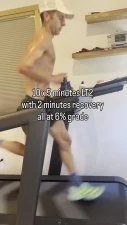
Massive uphill treadmill workouts around threshold, where athletes can accumulate way more volume than they could outside. This element seems especially important for athletes with intermediate/faster-twitch muscle fiber typology (another topic for another day!)
SIX: Zone Compression
This is our big training theory focus for pro athletes, with shorter distance athletes looking to compress VO2 and Critical Velocity, marathoners looking to compress VO2 and LT2, and ultra runners compressing LT1 and LT2. It's way too big of a topic to get into here. But a fun indicator: we know a marathoner is ready when they can do "float" recoveries on shorter workouts at their eventual marathon pace--i.e. they're shuttling lactate at wildly fast paces because their LT2 is wedged up closer than expected against their VO2. Or for me before 100 milers, my Z2 pace is way faster than predicted by my expected marathon pace.
SEVEN: Fatigue resistance emphasis
When studies look at fatigue resistance or durability, they normally measure exercise economy after a lot of work. They usually find that better fatigue resistance corresponds with athletes who can more effectively click into carbohydrate oxidation after large quantities of fat oxidation. With that in mind, most of our athletes do some "fatigue resistance hills" at the end of long efforts, and we encourage major fueling on all long efforts too. Fatigue resistance is a substrate problem with nervous system components, and our theory is that training the nervous system to be optimally primed is the key to overcoming genetic predispositions alone (interestingly, women and Type-1 fiber dominant seem to need to work on this element less).
EIGHT: Downhills are still relevant
Outside of fueling, the main element we're bringing from the trail/ultra world is an emphasis on downhills to improve strength. While it's not a huge focus, we've seen that when we fail to develop that skill, it often leads to worse performances especially at the marathon.
NINE: Uphill treadmill workouts/cross training double sessions
I'll keep this one short, since you've heard me talk enough already. But these types of 2-a-day moderate workouts and larger threshold sessions have become nearly ubiquitous at the top end of road running. However, there was an interesting offset--often, female athletes seemed to respond worse to double workouts. Our thinking is that doing 2 fast sessions is often excessive for athletes who have any adaptation limitations (all but the freakiest of freaks, mostly but not always men). Moving one session to uphill treadmill, elliptical, or bike seems to harness the best of all worlds.
OK, that was longer than expected. But there is so much more fun to come as we learn what's happening at the edge. Thank you for being on this journey with us and supporting us as we dive into new places. We love you all! HUZZAH!
6 years ago when the podcast first started, we primarily coached trail and ultra runners, especially at the professional level. Even a few years ago, most of the pros we coached focused on those events. We always dreamed of coaching pro road and track athletes, but there was a problem: how do you even get started? Who would trust a couple trail runners who had no serious road running history themselves?
It felt almost like having a dream to coach in the NBA. Cool! Also, good luck!
For athletes who provide for their families with running, a coaching decision can alter their lives long-term, both positively and negatively. Back in 2014, our trail credentials had a simple proof of concept: Megan. She's one of the best ever and won 2014 USATF trail AND ultra runner of the year. Then a few SWAP athletes had unexpected international success, and things took off (with some help from our Trail Runner Magazine articles, which provided a writing platform, and allowed us to include a byline mentioning coaching at the end).
On roads, it seemed unlikely that we'd find a way in. Then, we got lucky.
Some athletes wanted to do trails and roads, and they did great at both (led by superstar mountain running GOAT Grayson Murphy). That little spark led to us getting lucky again, as we connected with Allie Ostrander for trail/road training. A bit later, Jess McClain reached out. AllieO and Jess are two of the most loved and respected athletes in the world, and that helped with word of mouth since every other athlete looks up to them.
Now, we are getting to explore the road and track world in a way that we always dreamed of, but that never seemed possible. It's so incredibly fun and exciting, and such an honor! Our athletes always become our heroes, but with road running, it's sometimes like "ok now Steph Curry is reaching out to talk to you about shooting."
Taking this step also challenged us in new ways. Because every 0.5% matters (sometimes with 6 figures of income on the line for the athletes), it seemed clear that we needed to know EVERYTHING about what other coaches and athletes were doing. It's our old evolutionary argument: the selective pressure is so high in roads and track, with experiments being conducted all over the world all the time, that if something worked it would gain widespread adoption quickly.
However, as we have developed as coaches, we are seeing something else. That same selective pressure could be hiding an opportunity. When determining "success," there is availability bias that focuses on the outlier performances. So the training theory and practices were essentially answering the question "what does the best athlete in the world do?" Thus, even though the initial N value might be 50,000 (or however many road/track runners are at the pro level), the actual applied N value for training theory might be a small fraction of that. Sometimes it might even be 5 or 10 in different disciplines.
If we're actually deriving training theory from a small subset of athletes who have world-class performances, a couple problems arise.
First, outliers are outliers for a reason. Often, they just respond to things so differently than anyone else, including other world-class athletes.
Second, and this is the trickiest part--very few people at that level are fully open about what they do. What we see and hear is mostly true, but it's sometimes just untrue enough to be dangerous (the biggest example of that is bicarb, which was being used by almost everyone but had tons of articles saying people didn't use it...or take any supplements at all...or [insert industry "secret" here]).
Our approach:
learn everything we can learn, focusing on conversations and rumors as much as public resources.
Next, we always try to ground what we were seeing from other athletes and coaches in mechanisms from physiology and training theory (if there was no grounding that we could find, ask why we might be seeing that offset, since it probably shows where there's a big opportunity). The answers come from the real world, with studies and theories helping define "why?" so it can be replicable.
From there, trust athletes most of all, making it collaborative, since they are living in their bodies and they're smart as hell.
Finally, constantly evolve based on the data we personally gather. When 0.5% matters, you're seeing a lot of swings in both positive and less positive directions, so always ask "why," remembering that outliers are outliers for a reason even when we coach them.
Don't be afraid to question our own first principles either, and it's ok to be wrong. We can't be precious with any ideas, like a hedge fund looking to learn from every trading idea even if they don't personally put them into practice. Other coaches are brilliant. Learn from them.
And always stay on the lookout for new trends, looking for unexpected breakthroughs/broader movements rather than what the supreme outliers are doing.
As an example, here is a list of 9 things we are thinking about now based on that framework:
ONE: Bicarb/Nomio/CurraNZ
Bicarb supercharges workouts, usually 2 hours before workouts and long runs at relatively low doses (Bicarb 8-12 for most athletes). We became converts after coaching more track runners and seeing what was happening behind the scenes.
Nomio seems to enhance adaptive signaling, and we often have athletes try it 1 hour before bed the day before workouts and long runs, though we're still unsure on the best protocols. This one came from the cycling peloton mixed with fascinating studies on the underlying mechanism.
CurraNZ improves fat oxidation and heat performance, while possibly reducing stress. This one started in studies and extended to personal experience (taking it before Leadville last year), then piloting it with athletes and seeing unexpected performance/health improvements.
Megan always comments on how surprised she is that these supplements don't have wider adoption in roads. It's an advantage for us, for a short time longer at least.
TWO: Carbs/Carbs/Carbs
I resisted the urge to put this first, just so I wouldn't seem like a caricature of myself. Carbs during training allow athletes to push harder and adapt better. Running is far behind cycling, and that problem is especially evident for female runners. The carb signal and the training signal are tough to tease apart. You know how we feel about carbs.
THREE: Power/Power/Power
Tomorrow's episode has a big discussion on power, expanding on the "Dear Younger Me" article from last week. There sometimes seems to be a general offset in running training theory when it comes to power. In cycling, there are effective power meters, so every cyclist knows to optimize for being able to put out watts. That requires building up over a long time to do unthinkable things, with a requirement that top-end output is developed. When it comes to power, the ceiling defines the floor.
However, in running, so many elements can obscure the power signal, especially biomechanics and muscular breakdown. So it's easy to derive training signals that might not be the actual driver. For example, threshold-exclusive training programs work for VO2 max talents who have insane natural power, but seem to fail for athletes who are slightly older (and almost all women). Some theories assume that the outlier athletes are successful because of the threshold, rather than the natural (and temporary) power that lets them do shockingly economical threshold work to extend that power for longer durations.
Meanwhile, there are little elements in almost every training program (including threshold-heavy approaches) of short hills and speed. We think those little, unsexy elements might have an outsized importance, kind of like seeing 1 tsp of salt in a recipe and wondering whether the smallest ingredient might be the most important.
What that means in practice involves a lot of short hills and general speed development. Almost all of our pro road runners are doing at least 2 sets of hill strides per week on easy days, plus at least one more day of hill or flat strides, and usually one day with speed development. It's only a few total minutes per week in most cases, but take that away and our theory is that training would be flavorless for many athletes.
FOUR: Lower total intensity stress
So many road systems converged around a similar approach involving one speed day, one tempo/threshold day, and one quality long run day in a 6 or 7-day cycle. Our theory based on success and failure stories is that approach ends up selecting for athletes with abnormally strong adaptation rates. Throw 24 eggs at a wall, and the few that don't break will be called mentally tough monsters and the egg-throwing coach a genius, but it's not a choice to the egg whether it breaks.
Even short of breaking, 3 intense days in such a short window risks overwhelming the adaptive signal (the 10-day cycle being used by more and more road coaches is also intriguing for that reason). Some of the top male athletes we coach still do 3 quality days, but not every week, and using at least one of those days to off-load with a more gentle workout (or short hills), effectively creating a 10-day cycle within a 7-day week reality. Most of the time though, it's 2 workout days, with the long run counting as a workout stress. The big question we pose: how can we stack up these weekly bricks for years without needing to create significant mesocycles of rest/recovery that imply an athlete is overreached?
Basically, overreaching is the enemy outside of a few calculated big swings a year, since if you miscalibrate overreach by even a percent, it leads to regression (that's the definition of overreach that lasts more than a few days!).
FIVE: Develop the lactate shuttle
This training element has always been present in road training theory, but we started seeing it pop up in surprising places over the last decade. Whether it was Mike Smith's "1 mile T" thrown in at the end of workouts or Canova's long fartlek progressions, there seemed to be some magic in doing sustained work after fast/powerful work.
Thus, we think a lot about how to develop the lactate shuttle. Lactate is not the enemy, but a preferred fuel source. Whether it's a 5k or a marathon, the lactate shuttle determines how efficient an athlete runs before fatigue overwhelms them. Aside from general aerobic training for mitochondrial efficiency, some ways to work on the lactate shuttle that we use:
threshold or steady running after workouts (you'll see this a ton in our more recent training plans)
Floats for workout recoveries, where intervals involve intentional running between them
Mixed pace intervals around threshold, which is a key element in our theory of "zone compression" (a bigger topic for another day)
Massive uphill treadmill workouts around threshold, where athletes can accumulate way more volume than they could outside. This element seems especially important for athletes with intermediate/faster-twitch muscle fiber typology (another topic for another day!)
SIX: Zone Compression
This is our big training theory focus for pro athletes, with shorter distance athletes looking to compress VO2 and Critical Velocity, marathoners looking to compress VO2 and LT2, and ultra runners compressing LT1 and LT2. It's way too big of a topic to get into here. But a fun indicator: we know a marathoner is ready when they can do "float" recoveries on shorter workouts at their eventual marathon pace--i.e. they're shuttling lactate at wildly fast paces because their LT2 is wedged up closer than expected against their VO2. Or for me before 100 milers, my Z2 pace is way faster than predicted by my expected marathon pace.
SEVEN: Fatigue resistance emphasis
When studies look at fatigue resistance or durability, they normally measure exercise economy after a lot of work. They usually find that better fatigue resistance corresponds with athletes who can more effectively click into carbohydrate oxidation after large quantities of fat oxidation. With that in mind, most of our athletes do some "fatigue resistance hills" at the end of long efforts, and we encourage major fueling on all long efforts too. Fatigue resistance is a substrate problem with nervous system components, and our theory is that training the nervous system to be optimally primed is the key to overcoming genetic predispositions alone (interestingly, women and Type-1 fiber dominant seem to need to work on this element less).
EIGHT: Downhills are still relevant
Outside of fueling, the main element we're bringing from the trail/ultra world is an emphasis on downhills to improve strength. While it's not a huge focus, we've seen that when we fail to develop that skill, it often leads to worse performances especially at the marathon.
NINE: Uphill treadmill workouts/cross training double sessions
I'll keep this one short, since you've heard me talk enough already. But these types of 2-a-day moderate workouts and larger threshold sessions have become nearly ubiquitous at the top end of road running. However, there was an interesting offset--often, female athletes seemed to respond worse to double workouts. Our thinking is that doing 2 fast sessions is often excessive for athletes who have any adaptation limitations (all but the freakiest of freaks, mostly but not always men). Moving one session to uphill treadmill, elliptical, or bike seems to harness the best of all worlds.
OK, that was longer than expected. But there is so much more fun to come as we learn what's happening at the edge. Thank you for being on this journey with us and supporting us as we dive into new places. We love you all! HUZZAH!

Comments (0)